
For years, consultants sold tools, and businesses bought them, CRMs, scheduling apps, communication platforms, analytics dashboards, and automation software. Yet results often stayed the same. Complexity grew, teams felt overwhelmed, and many systems went unused. The future of consulting infrastructure changes this. It’s not about more tools, it’s about building unified systems. Scattered platforms work together, and what was once chaos becomes control.
| TL;DR Summary Book a call with Muhammad Nouman to assess your systems and build a roadmap for modern, future-ready consulting infrastructure. The future of consulting infrastructure isn’t about buying more tools, it’s about building unified systems that guide teams, streamline workflows, and deliver measurable results. Traditional approaches using isolated CRMs, apps, and dashboards often create complexity, wasted effort, and underused software. Modern consulting infrastructure integrates AI-guided systems with human expertise to automate routine tasks, provide real-time recommendations, and turn engagement into meaningful action. This approach centralizes operations, reduces friction, and ensures consistent outcomes across teams. Consultants now act as system architects, designing connected environments rather than just giving access to tools. Platforms like GoHighLevel allow seamless integration, automated workflows, unified reporting, and scalable growth, enabling firms to track results, improve client experience, and increase efficiency. Getting started involves auditing existing tools, mapping workflows, implementing integrated systems gradually, and continuously optimizing performance. The result: less complexity, measurable outcomes, and sustainable growth for consulting and professional service firms. |
My name is Muhammad Nouman. I help consultants build systems using GoHighLevel. I focus on the future of consulting infrastructure. But infrastructure isn’t just about technology, it needs a clear strategy and thoughtful architecture. If your tech feels scattered, reach out. In our session, we’ll review your systems and design a roadmap. This is how the future of consulting infrastructure comes to life.
Why the Tool Approach Failed
Organizations invested heavily. Companies bought CRMs, project tools, communication platforms, and automation software. Yet results often stayed disappointing. Teams reported rising complexity, low usage, and a sense of lost control.
The problem wasn’t the quality of the tools, most platforms work well. The issue was coordination. Tools existed in isolation, workflows stayed broken, and data lived in silos. As a result, technology went unused. The future of consulting infrastructure solves this problem.
Without unified systems, even the best tools fail. Features go unused, teams feel confused, and workflows break down. Money alone doesn’t produce results. The future of consulting infrastructure demands smarter, connected approaches.
The Limits of Access-Only Consulting
Traditional consulting relied on access models. Consultants gave platform access and shared documents. Companies provided software licenses. Yet this approach shifted the burden to teams. Staff often lacked the skills to use tools effectively, coordination became difficult, and decisions stayed scattered.
As a result, problems multiplied. Teams missed follow-ups, duplicated work, and communication broke down. Delays became frequent, and accountability dropped. Access alone was not enough. The future of consulting infrastructure solves this by providing guidance.
Giving teams disconnected tools isn’t a strategy, it creates confusion. Users face too many choices, and opportunities slip away. Operations need clear direction. The future of consulting infrastructure provides exactly that: systems that guide teams and keep work on track.
How AI Systems Are Transforming Consulting
The future of consulting infrastructure leverages AI, and platforms like GoHighLevel are at the forefront of this shift. For example, these systems understand intent and analyze data quickly. They don’t just store information; instead, they suggest the next actions automatically. In contrast, old frameworks only offered links, and dashboards required manual effort. As a result, users often faced friction and delays.
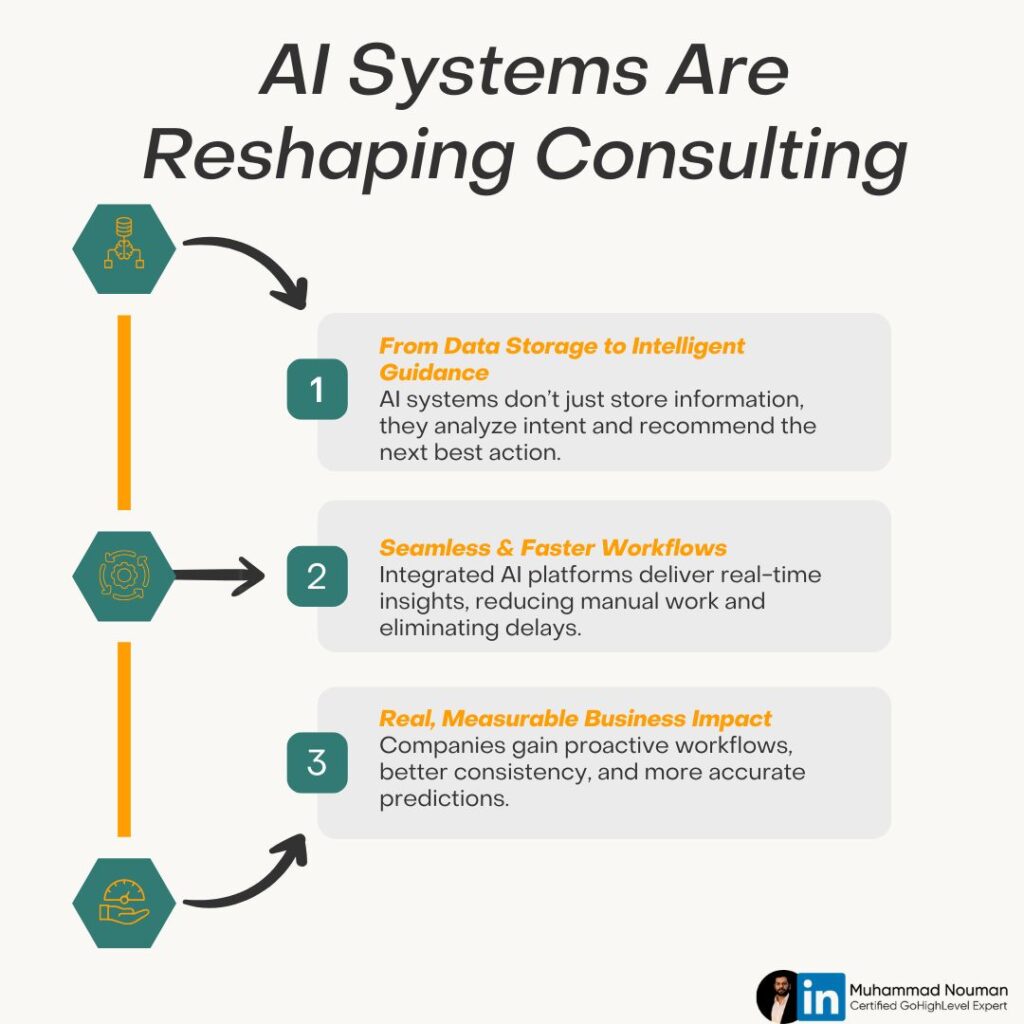
AI-guided systems, such as GoHighLevel, work differently. Specifically, they combine information seamlessly and deliver recommendations in real time. Consequently, manual work becomes unnecessary, and workflows move smoothly. In other words, this is the difference between merely storing data and actively guiding work.
Companies using integrated AI systems like GoHighLevel see tangible change. First, outdated workflows become proactive. Additionally, consistency improves, and predictions become more accurate. Therefore, performance is measurable, and the future of consulting infrastructure drives real transformation.
From Engagement to Action
Old metrics focused on engagement. Companies counted logins, and teams tracked clicks. Systems measured page views. However, these numbers rarely reflected real results. The future of consulting infrastructure, powered by platforms like GoHighLevel, changes the way we measure success.
Centralized systems now measure action. Teams track completed appointments, and systems monitor finished onboarding. Firms watch executed workflows, and companies record follow-ups. Together, these metrics reflect actual performance, not just activity.
When users get timely guidance from tools like GoHighLevel, behavior improves. People use resources correctly, staff complete steps, and teams respond to messages. Workers follow processes consistently. As a result, engagement turns into meaningful action. The future of consulting infrastructure focuses on outcomes, not just activity.
Mixing Tech with Human Touch
Automation helps companies scale. Platforms like GoHighLevel handle routine tasks, schedule reminders, collect data, and even create documents, freeing advisors to focus on strategy. However, complex cases still require human expertise, which is why effective systems blend both approaches.
Human skill remains essential for problem-solving. Consultants build relationships, and teams make strategic decisions, ensuring companies can scale without losing trust or quality. Ultimately, the future of consulting infrastructure balances technology with the human touch.
For clinics and consulting firms ready to integrate AI-powered systems and automation seamlessly, Muhammad Nouman’s Marketing Automation services provide expert guidance, implementing tools like GoHighLevel to streamline workflows and maximize results.
The Consultant’s New Role
The value of consulting has changed. Now, consultants don’t just advise, they design infrastructure. In addition, they connect solutions across platforms. AI identifies inefficiencies, while systems spot waste, and software uncovers new opportunities. Together, these tools provide insights that were previously hidden.
Simulation helps teams visualize changes. They can test scenarios virtually, and systems show outcomes in real time. As a result, leaders evaluate options based on data rather than guesses. Ultimately, the future of consulting infrastructure turns consultants into architects.
Consultants now engineer systems and build integrated environments. Moreover, teams design solutions collaboratively. Consequently, advice transforms into action. The future of consulting infrastructure demands this evolution.
Building Systems with GoHighLevel
GoHighLevel provides the architecture companies need. For example, the platform integrates communication and ensures automation runs smoothly. Systems schedule tasks automatically, and reporting stays unified. In addition, management can connect everything in one place. As a result, the future of consulting infrastructure relies on platforms like this.
Through structured workflows, companies achieve consistent standards. Onboarding becomes uniform, and systems coordinate communication across teams. Moreover, platforms monitor progress, and software guides users. Consequently, follow-ups stay consistent, friction decreases, and leadership can focus on strategy. Ultimately, the future of consulting infrastructure enables this kind of seamless progress.
Key Benefits of Infrastructure
A strong consulting infrastructure is more than just technology; in fact, it’s the backbone of seamless operations and sustainable growth. Modern platforms are designed to unify processes, guide teams, and provide measurable insights. By doing so, they reduce friction and support expansion, empowering businesses to work smarter and scale efficiently. Here, we explore the key benefits that make this future-ready infrastructure indispensable.
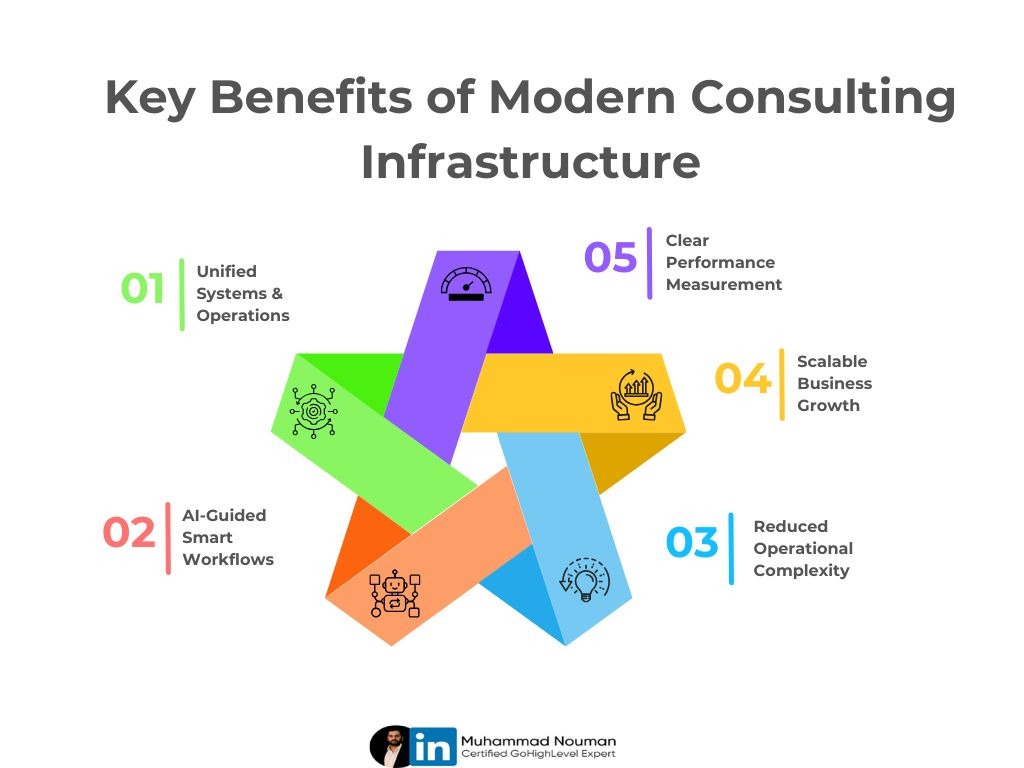
Unified Operations
All systems connect, and data flows automatically. Also, workflows stay synced, and teams access everything from one place. So, fragmentation disappears. The future of consulting infrastructure delivers true unity.
Active Guidance
Systems guide users, and software suggests next steps. In addition, platforms rank actions and remove friction. As a result, productivity increases. The future of consulting infrastructure provides clear guidance.
Measured Outcomes
Systems track performance, while platforms measure actions. Moreover, software monitors workflows, making results visible. Then, companies can prove ROI. The future of consulting infrastructure emphasizes measurement.
Scalable Growth
Infrastructure supports growth, and systems handle more clients. At the same time, quality stays high, and complexity doesn’t increase. Therefore, growth becomes sustainable. The future of consulting infrastructure enables scaling.
Less Complexity
Unified systems simplify operations, and switching tools decrease. Also, silos disappear, and training becomes easier. Thus, teams work efficiently. The future of consulting infrastructure reduces friction.
Real Applications of Consulting Infrastructure
Consulting firms are already using modern infrastructure successfully. Systems automate onboarding, and platforms also coordinate communication. Software streamlines service delivery, while tools simplify reporting. As a result, the future of consulting infrastructure transforms how services are delivered.
Service businesses benefit from unified systems as well. Software qualifies leads, and systems schedule appointments automatically. Platforms manage follow-ups, and consequently, conversion rates improve while revenue per client increases.
Professional services centralize operations with these systems. Coordination improves dramatically, and in addition, client experience gets better. Delivery remains consistent, and therefore, retention increases. Ultimately, the results speak for themselves.
Getting Started
Start by auditing your systems. Which tools are in use, and how do they connect? Where are the gaps, and are there any duplicates? This step guides your strategy. Platforms like GoHighLevel make this process seamless.
Next, define workflows. Map client journeys and identify automation opportunities. Design integration points carefully. As a result, your planning is clear and effective. Planning is essential for success.
Then implement it systematically. Begin with core processes and connect tools gradually. Test workflows thoroughly, and ensure teams are trained properly. Consequently, adoption succeeds, and systems are used effectively.
Finally, optimize continuously. Monitor performance metrics and gather feedback regularly. Use data to improve processes. Therefore, your systems get better over time, and improvement becomes ongoing.
For expert guidance on implementing GoHighLevel and building fully automated, efficient workflows, check out Muhammad Nouman’s Services to streamline your business operations and maximize results.
About Muhammad Nouman
I’m a Certified GoHighLevel Expert, and I focus on the future of consulting infrastructure. I’m also the founder of Ignitto, where I help consulting firms implement systems that truly work. Moreover, service and professional firms rely on my expertise to improve operations and results.
My goal is simple: I build infrastructure that delivers measurable outcomes. Also, consultants using my systems achieve better performance. I’ve helped increase client retention by 200 percent through thoughtful system design and proper implementation. Clearly, expertise and strategy make all the difference.
Every consulting firm is unique. That’s why I provide customized solutions. First, I assess existing systems and study workflows in detail. Then, I identify challenges and design solutions tailored to each firm. From assessment to implementation, I ensure systems work seamlessly.
I also provide coaching to help consultants understand the future of consulting infrastructure. Additionally, I cover topics like system design and integration strategies. Therefore, if your firm is modernizing or scaling, I’m here to guide you every step of the way.
Transform Your Practice
Does your tech stack feel broken? The future of consulting infrastructure is what you need. Let’s discuss your situation. Consulting firms work with me because I build infrastructure that works.
Book Your Free Strategy Session Now. I’ll review your systems and find gaps. Then I’ll create a roadmap for your firm. Real transformation comes to you.
Affiliate Disclosure
Some links on this page are affiliate links. If you purchase through them, I may earn a commission at no extra cost to you.
Visit our Website Iloveghl for more Articles







Be First to Comment