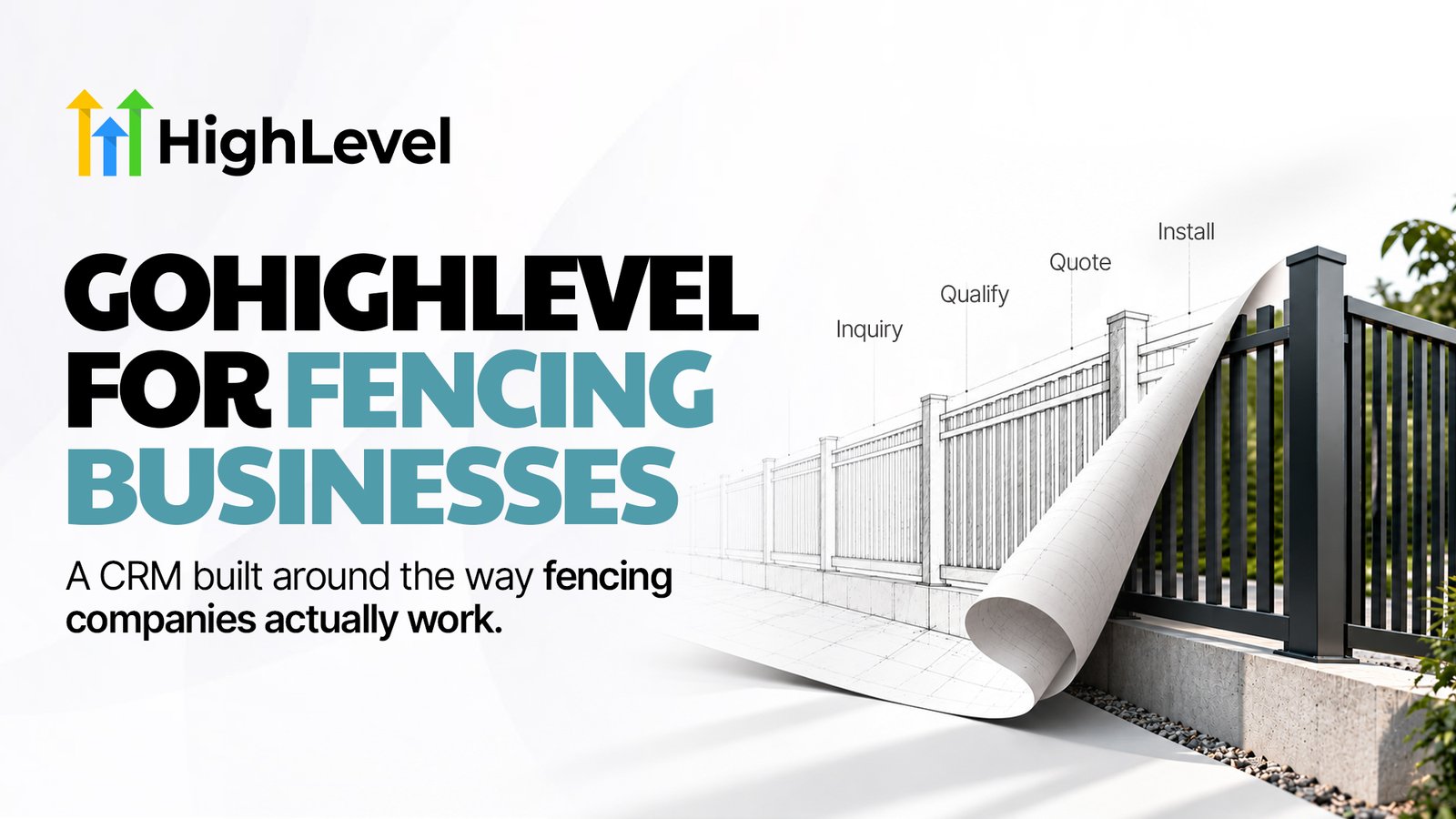
I have spent years helping businesses implement GoHighLevel, CRM infrastructure, marketing automation, lead management systems, and AI-powered processes. One thing I have learned is that a CRM becomes valuable when it is designed around the way a business actually operates.
That is especially true for fencing companies, where missed calls, slow follow-ups, and delayed estimates can quickly turn good leads into lost opportunities.
This is where GoHighLevel for fencing companies becomes interesting. Instead of forcing a fencing contractor into a generic CRM structure, you can build the system around the actual customer journey of a fencing business.
| TL;DR 1. GoHighLevel can be customized around how fencing companies actually operate, instead of using a generic CRM structure. 2. Lead management and fast response are critical because missed calls, slow follow-ups, and delayed replies can quickly turn good fencing leads into lost opportunities. 3. A fencing CRM should track the entire customer journey through a clear pipeline, from New Lead and Qualification to Estimate, Contract, Installation, Payment, and Completion. 4. Lead qualification and source tracking help businesses capture project details such as fence type, size, location, material, and timeframe while also identifying which marketing channels generate the best opportunities. 5. Estimate scheduling and follow-up should be automated using online booking, reminders, missed-call text back, notifications, and helpful follow-up sequences after quotes are sent. 6. The CRM should continue supporting customers after the sale with installation updates, payment communication, review requests, and referral campaigns. 7. Old leads and previous estimates should be reactivated through targeted campaigns instead of being treated as dead contacts. 8. Book a call with Muhammad Nouman, a Certified GoHighLevel Expert and business strategist, to discuss building a fencing specific CRM with the right automation, AI, lead management, follow up, and customer journey for your business. |
The CRM Problem Behind Fencing Lead Generation
Fencing companies operate in a particularly interesting environment from a CRM perspective.
A homeowner may find a fencing company through Google, Facebook, a referral, a yard sign, an old customer, or another local marketing channel. They might call immediately, submit a form, send a message, or request a quote online.
The problem starts when that inquiry enters the business.
If the owner is on a job site, the phone may go unanswered. If somebody does answer, the lead may not be entered into a structured system. The customer might receive a response several hours later, but by that point they may already be speaking with another contractor.
Even after the appointment is booked, there are still several opportunities for the process to break down. Information can be missed, appointments can require unnecessary back-and-forth, quotes can sit without follow-up, and older opportunities can gradually disappear from view.
This is why I would not approach a fencing company CRM as simply a place to store contact information.
The CRM should support the business process from beginning to end.
Understanding the Fencing Customer Journey
A fencing project has a natural progression. Someone becomes interested in a fence, contacts the company, provides information about the project, schedules an estimate, meets with the estimator, receives a quote, and eventually decides whether to move forward.
Once the customer accepts, the process changes again. Installation needs to be scheduled, the project needs to be completed, payment needs to be collected, and the customer can eventually become a source of reviews and referrals.
That means a fence contractor CRM needs to account for more than the sales conversation.
The sales process and the operational process are connected. A good system should make it easier for the team to understand where a customer is, what has already happened, and what needs to happen next.
This is also where GoHighLevel can be useful. Its CRM, pipelines, calendars, forms, communication tools, workflows, and reporting can be structured around the customer journey rather than being treated as separate features.
Where Fencing Companies Get Their Leads
Before building any automation, I would first look at where the fencing company is actually getting its opportunities.
Google Search and Google Business Profile can be particularly important because people searching for a fencing contractor often already have a project in mind. Facebook and Instagram can generate demand and awareness, while referrals can bring in customers who already have some level of trust in the company.
There are also past customers, old estimates, local advertising, yard signs, SEO, and home-service lead marketplaces.
The important part from a CRM perspective is that these sources should not disappear once the lead enters the database.
A fencing company CRM should make it possible to see where opportunities are coming from and how those leads perform over time. If Google consistently produces higher-quality projects than another source, that is useful information when deciding where to invest more marketing budget.
Lead source tracking is therefore not just a reporting feature. It can become part of the company’s decision-making process.
Responding Quickly to New Leads
One of the simplest improvements a fencing company can make is also one of the easiest to overlook: responding quickly.
A fencing company does not need to replace every human interaction with automation. But when a new lead comes in and nobody is available to respond immediately, an automated response can acknowledge the inquiry and create a better handoff.
For example, a missed call could trigger a text message letting the person know the company received the call and will follow up. A website form could create the contact in GoHighLevel, notify the team, and send an appropriate confirmation message.
An AI receptionist can take this further by answering calls, handling common questions, qualifying prospects, and helping with appointment booking when configured correctly.
The objective is not to make the business feel robotic. It is to prevent the first stage of the customer journey from depending entirely on whether someone happened to be holding the phone at that exact moment.
Qualifying Leads Before an Estimate
Not every person asking about a fence is necessarily ready for an estimate.
Some may have a clear project in mind. Others may still be researching options. A homeowner might know the type of fence they want but have no idea about the approximate size, while another customer may already have measurements, property information, or a specific installation timeframe.
A qualification form can help collect some of that information before the appointment.
For a fencing company, the form could capture details such as the type of project, approximate fence length, preferred material, property location, desired timeframe, and other information the company considers important.
This information can then be stored in the CRM instead of living inside an email inbox or a conversation thread.
Lead scoring can also be used where it makes sense. The purpose is not to create a complicated scoring model. It is simply to give the team another way to prioritize opportunities and understand which leads may require attention first.
Making Estimate Scheduling Easier
Estimate scheduling is another area where a fencing business can lose a surprising amount of time.
Without a structured booking process, the conversation can become a series of messages about availability. The customer suggests a day, the estimator is unavailable, another time is proposed, and the process continues until both sides finally agree.
A calendar connected to the CRM can reduce that friction.
Once a qualified prospect is ready to schedule, they can select an available time based on the company’s calendar rules. Confirmation messages and reminders can then be handled automatically through SMS or email.
The benefit is not simply saving a few messages. It gives the company a more predictable process and reduces the possibility that an interested customer gets stuck waiting for someone to coordinate the appointment.
Collecting Property and Project Information
The site visit is an important part of the fencing process because the estimator needs more than a customer’s name and phone number.
Property boundaries, existing structures, access, HOA requirements, permits, neighboring properties, and other project-specific details can affect the work. The exact requirements will vary by project and location, but the CRM can still provide a structured place to collect information.
For example, a fencing workflow can include requests for property surveys where available, confirmation that property boundaries have been reviewed, HOA documentation when applicable, and notes about neighbor coordination.
This is one of those areas where a CRM can support operations without trying to replace the estimator’s judgment.
The system is there to make sure important information is captured and visible. The actual assessment of the property still belongs to the people responsible for the project.
Following Up After Sending the Quote
For many service businesses, the sales process does not end when the estimate is sent.
A homeowner may need time to think about the project. They might be comparing contractors, discussing the budget with a spouse, waiting for financing, or simply have become distracted by other things happening in their life.
That is why quote follow-up deserves its own process.
Instead of relying on someone to remember every estimate that needs a follow-up, GoHighLevel can trigger a sequence based on the stage of the opportunity. The messaging can be designed to remain helpful rather than becoming a series of aggressive sales reminders.
For example, the first follow-up might simply confirm that the customer received the estimate. Later communication could answer common questions, invite the customer to discuss the project, or provide another opportunity to move forward.
The exact timing should be based on the company’s actual sales cycle. Automation should support that process rather than impose an arbitrary sequence.
Building a Fencing-Specific CRM Pipeline
This is where I think the difference between a generic CRM and a properly designed GoHighLevel Fencing CRM becomes clear.
A fencing company should be able to open its pipeline and immediately understand what is happening with each opportunity.
A practical pipeline could look something like this:
| Stage | Purpose |
| New Lead | A new inquiry has entered the system |
| Lead Qualification | The project is being qualified |
| Estimate Requested | The prospect is ready for an estimate |
| Estimate Appointment Scheduled | A site visit has been booked |
| Site Visit Completed | The estimator has completed the visit |
| Estimate Sent | The quote has been delivered |
| Follow-up / Negotiation | The customer is considering the proposal |
| Contract Signed | The opportunity has been won |
| Installation Scheduled | The project has moved into production |
| Installation Completed | The fencing work is complete |
| Payment Pending | Final payment or outstanding balance remains |
| Completed / Review Requested | The customer journey is moving into reviews and referrals |
The exact stages will vary between companies, and I would not recommend copying a pipeline blindly.
The important principle is that the stages should represent meaningful changes in the customer’s relationship with the business.
If the pipeline reflects reality, it becomes much easier for the owner and team to understand what needs attention.
Managing Installation After the Sale
A common CRM mistake is to treat the signed contract as the end of the journey.
For a fencing company, it is really the beginning of another operational phase.
Once a customer agrees to move forward, the company still needs to coordinate installation, communicate with the customer, manage scheduling, track project status, and eventually collect payment.
Some of these processes may belong in specialized operational or accounting software depending on the business. GoHighLevel does not need to replace every system the company already uses.
Instead, it can provide the communication and customer-management layer around those processes.
That distinction is important. A good CRM does not have to become the only piece of software in the company. It needs to make the overall system easier to manage.
Reviews Are Part of the Customer Journey
A completed fencing project creates another opportunity that is often underused: the customer review.
A satisfied homeowner may genuinely want to recommend the company, but that does not mean they will remember to leave a review without being prompted.
This can be incorporated into the post-installation workflow.
Once the appropriate stage of the project has been reached, the system can send a review request through the company’s chosen communication channel. The timing can be adjusted around the actual customer experience rather than sending a request immediately after installation.
Over time, this can help create a more consistent review-generation process instead of relying entirely on customers to take the initiative.
Turning Customers Into Referral Opportunities
Reviews and referrals are related, but they are not the same thing.
A customer who had a good experience may leave a review, but they may also know a neighbor, family member, or friend who needs fencing.
That makes the post-project relationship valuable beyond the original transaction.
A fencing company can build a referral process into its CRM so that customers are given an appropriate opportunity to refer someone after the project has been completed. Again, the goal is not to bombard people with messages. It is to create a structured opportunity that otherwise might never happen.
This is one of the advantages of having the customer journey represented inside the CRM. The company can continue communicating with customers after the installation rather than effectively forgetting about them once the invoice has been paid.
Your Old Leads May Still Be Valuable
One of the most overlooked assets in a local service business is its existing database.
A fencing company may have hundreds or thousands of old leads that requested estimates, asked questions, or started conversations but never became customers.
Some of those opportunities may genuinely be dead. Others may simply have been delayed.
A homeowner who was not ready for a fence six months ago might now be ready. A project may have been postponed because of budget, timing, another renovation, or circumstances that have since changed.
This is where a reactivation campaign can make sense.
Rather than treating old contacts as useless records, the company can segment them and create appropriate re-engagement campaigns. GoHighLevel can then help automate the communication while keeping responses connected to the CRM.
For a business that has already invested money into generating those leads, that existing database can be worth revisiting before spending more money to find completely new prospects.
Keeping Customer Communication Organized
Fencing businesses can end up communicating with customers across several channels.
There may be phone calls, SMS messages, emails, website forms, Facebook messages, and other conversations happening at different points in the sales process.
When that information remains scattered, it becomes harder for the team to understand the customer’s history.
A CRM gives the company a central place to organize that context.
The value is especially obvious when someone other than the owner needs to handle the conversation. Instead of asking the customer to repeat everything or searching through different applications, the team can look at the contact record, pipeline stage, notes, previous communication, and relevant project information.
That is one of the reasons I tend to think of GoHighLevel as more than a CRM. When properly configured, it becomes part of the operating infrastructure of the business.
AI, Automation, and CRM Should Have Different Jobs
There is an important distinction between AI, automation, and the CRM itself.
The CRM should hold the customer context and give the team visibility into what is happening. Automation should handle predictable processes such as reminders, notifications, follow-ups, and review requests.
AI is useful when the interaction requires more flexibility.
An AI receptionist, for example, can have a conversation with a prospective customer rather than simply sending a predetermined message. It can answer certain questions, collect information, and potentially help schedule an appointment.
I would not start with AI simply because AI is available, though.
The underlying process needs to make sense first. If the company does not know how it wants to qualify leads, schedule estimates, handle quotes, or follow up with prospects, adding an AI layer will not magically solve the underlying problem.
Automation Cannot Fix a Bad Fencing Process
This is one of the principles I come back to repeatedly when designing CRM systems.
It is easy to look at GoHighLevel and immediately think about workflows, triggers, tags, pipelines, AI agents, and campaigns. But technology should come after process design.
If a fencing company has an unclear sales process, automating that process simply makes the confusion happen faster.
I would start by understanding how the company currently handles its customer journey. That means looking at where leads come from, how quickly the team responds, how estimates are scheduled, what information the estimator needs before visiting a property, and what happens after a quote is delivered.
From there, I would look at the process after the sale. Installation scheduling, payment collection, review requests, referrals, and follow-up with older leads all need to fit into the same overall system.
Once that process is clear, it becomes much easier to decide which parts should be handled through GoHighLevel, which should remain manual, and where AI or automation can actually add value.
Reporting Gives the Business a Different View
Once the customer journey is structured, the company can start measuring what is actually happening.
Instead of simply knowing that leads are coming in, the business can begin looking at where those leads came from, how many were qualified, how many estimates were scheduled, how many quotes were sent, and how many opportunities became customers.
That creates a much more useful picture of the sales process.
For example, if a company generates a large number of leads from one channel but very few become estimates, that may indicate a lead-quality problem. If estimates are being completed but quotes rarely move forward, the issue may exist later in the sales process.
The CRM does not automatically tell you why something is happening, but it can give you the visibility needed to start asking better questions.
Why Fencing Is an Interesting Niche for GoHighLevel
I think fencing is an interesting niche for GoHighLevel because the customer journey contains many of the processes where CRM and automation can provide real value.
There is lead generation, fast response, qualification, appointment scheduling, site visits, estimates, quote follow-up, installation communication, reviews, referrals, and reactivation.
At the same time, the business is still highly personal. A homeowner is not buying a generic digital product. They are hiring a company to make a significant improvement to their property, often involving a meaningful financial investment.
That makes the balance between automation and human interaction especially important.
The best system should remove repetitive administrative work while preserving the personal communication that helps a local fencing company earn trust.
Building a Connected Fencing CRM
This is also why I would not recommend building the system as a collection of unrelated automations.
The missed-call workflow should connect to the CRM. The CRM should connect to qualification. Qualification should connect to scheduling. The estimate stage should connect to quote follow-up. Completed projects should connect to reviews and referrals.
Each part should have a reason for existing.
When the pieces are connected, the company gets something much more useful than a collection of individual features. It gets a system that follows the customer through the business.
And that is ultimately what I think a good fencing business software solution should do.
I Built a Fencing-Focused System Around This Idea
While working through this project, I wanted to take the concept beyond simply writing about what a fencing CRM could look like. So I created a dedicated fencing-focused system called FenceFlow, built around the processes discussed in this article.
The idea is to bring lead management, qualification, estimates, follow-up, customer communication, and the rest of the fencing customer journey into a more structured system. If you want to see what that looks like in practice, you can explore the sales page here: Explore FenceFlow for Fencing Companies
The project is also a useful example of how I approach niche CRM systems. Rather than starting with a list of GoHighLevel features, I start by understanding the business itself—its processes, challenges, and goals, and then work backward into the technology to build a system that actually fits.
If you’re looking to build or optimize a CRM around the way your business truly operates, book a call with Muhammad Nouman, a Certified GoHighLevel Expert.
Should a Fencing Company Use GoHighLevel?
I would not say that every fencing company needs GoHighLevel.
If a company is very small, has a simple lead flow, receives only a handful of inquiries, and already has a process that works well, adding a large CRM system may create more complexity than value.
But as the business grows, the weaknesses of an informal process become more visible.
Lead growth increases the need for consistent follow-up. A larger estimating team requires better scheduling coordination. Customer growth creates more communication to manage, while completed projects open the door to more reviews and referrals.
At that point, having a structured fencing company CRM can become much more valuable.
GoHighLevel is particularly interesting because it can bring CRM, communication, calendars, forms, workflows, marketing, AI, and reporting into one environment instead of requiring the company to build its entire customer-management process across disconnected tools.
Start With the Business Process
If I were building a GoHighLevel system for a fencing company from scratch, I would not begin by opening the workflow builder.
I would begin with the business.
I would map how a lead currently enters the company, how the team responds, what information is collected, how estimates are scheduled, what happens during the site visit, how quotes are delivered, how follow-up works, and what happens when the customer says yes.
Then I would map the post-sale experience, including installation, payment, reviews, referrals, and future communication.
Only after that would I start deciding which parts belong in GoHighLevel.
That approach produces a much better CRM because the technology is being built around an existing business logic rather than forcing the business to adapt to a software template.
Start With GoHighLevel
If you are a fencing company owner or agency building systems for fencing contractors, GoHighLevel can provide a strong foundation for this type of CRM.
You can start with the basic customer journey and gradually introduce more advanced functionality as the business actually needs it.
I’m Muhammad Nouman, a Certified GoHighLevel Expert and business strategist, helping fencing companies turn scattered leads, manual follow-ups, estimates, appointments, and customer communication into structured systems that make the business easier to manage and scale.
Want Me to Help You Design the System?
The technology is only one part of the project.
The more important question is how the system should actually work for the business. That includes the pipeline structure, lead qualification, follow-up strategy, calendars, communication, automations, AI, reporting, and the handoff between sales and operations.
If you want help designing that strategy, you can book a short session with me here:
Book a 15-Minute Strategy Session
If you’re working on a fencing CRM, planning to build a niche SaaS, or exploring how GoHighLevel could fit into your existing operation, connect with Muhammad Nouman, a Certified GoHighLevel Expert.
Frequently Asked Questions About GoHighLevel for Fencing Companies
What is GoHighLevel for fencing companies?
GoHighLevel can be used as a centralized CRM and automation platform for fencing businesses. It can help manage leads, qualification, estimate appointments, quote follow-up, customer communication, reviews, referrals, and reactivation campaigns from one system.
What should a fencing company automate first?
I would start with the areas where leads are most likely to be lost: new-lead response, missed-call follow-up, qualification, estimate scheduling, appointment reminders, and quote follow-up. Once those processes are working reliably, the company can expand into reviews, referrals, reactivation, and more advanced AI workflows.
Can GoHighLevel help fencing companies respond to missed calls?
Yes. A fencing company can use features such as missed-call text back and automated notifications to respond when a call is missed. An AI receptionist can also be configured to answer calls, collect information, handle certain questions, and help with appointment scheduling.
Can GoHighLevel qualify fencing leads before an estimate?
Yes. A fencing company can create a qualification form or questionnaire to collect information about the project before scheduling an estimate. Details such as project requirements, fence type, approximate size, location, and desired timeframe can help the team understand the opportunity before the site visit.
Can GoHighLevel automate fence estimate follow-up?
Yes. Once an estimate or quote has been sent, GoHighLevel can trigger follow-up workflows through SMS or email. The timing and messaging can be customized around the fencing company’s actual sales process instead of relying on someone to manually remember every quote that needs attention.
Can GoHighLevel manage the fencing sales pipeline?
Yes. A fencing company can create a pipeline that reflects its actual customer journey, from New Lead and Lead Qualification through Estimate Sent, Contract Signed, Installation Scheduled, and Completed / Review Requested.
Can a fencing company use GoHighLevel for reviews and referrals?
Yes. Review requests and referral campaigns can be incorporated into the post-installation customer journey. Once a project reaches the appropriate stage, the system can automatically send a review request or create an opportunity for the customer to refer someone they know.
Can GoHighLevel reactivate old fencing leads?
Yes. Old leads and previous estimates can be segmented and placed into re-engagement campaigns. This gives fencing companies a way to reconnect with prospects who were not ready to move forward when they originally contacted the business.
Does a fencing company need a separate CRM if it uses GoHighLevel?
Not necessarily. GoHighLevel can serve as the central CRM and communication layer for many of these processes. However, a fencing company may still need specialized software for certain operational, accounting, estimating, or project-management requirements. The goal should be to connect the right tools rather than replace every system with one platform.
Is GoHighLevel good for small fencing companies?
It can be, particularly when a company is starting to receive enough leads that manual follow-up and scheduling become difficult to manage. Smaller companies should still keep the system simple and only automate processes that genuinely save time or improve the customer experience.
How much does it cost to build a fencing CRM in GoHighLevel?
The cost depends on how the system is designed and how much functionality the company needs. A basic setup with CRM, pipeline, forms, calendar, and follow-up automation is considerably simpler than a more advanced system involving AI receptionists, multiple workflows, integrations, reporting, and custom processes.
What should a fencing company automate first?
I would start with the areas where leads are most likely to be lost: new-lead response, missed-call follow-up, qualification, estimate scheduling, appointment reminders, and quote follow-up. Once those processes are working reliably, the company can expand into reviews, referrals, reactivation, and more advanced AI workflows.
Final Thought
A fencing company does not necessarily need more software.
It needs a better way to manage the process it already has.
The opportunity with GoHighLevel for fencing companies is not simply to automate texts or create another pipeline. It is to connect the different parts of the customer journey so that leads are handled properly, estimates move forward, customers receive consistent communication, and opportunities do not disappear simply because nobody remembered the next step.
When the CRM is designed around the business, GoHighLevel becomes much more than a database.
It becomes part of the system that helps the business operate.
Affiliate Disclosure
This article contains affiliate links. If you purchase GoHighLevel through my affiliate link, I may earn a commission at no additional cost to you. I recommend tools and platforms based on their potential value for the businesses and systems I work with.









Be First to Comment