Patient no-shows are draining your clinic’s revenue every single week. Not slowly. Not occasionally. Consistently, month after month, without anyone noticing where the money went.
| TL;DR Summary Patient no-shows are quietly costing clinics thousands in lost revenue every month, often without being fully tracked. Each missed appointment is not just lost income for that slot, but also wasted staff time and a high risk that the patient never returns at all. If you want to see exactly how much this is impacting your clinic and how to fix it, you can Book a Strategy Session to map it out clearly. Most patient no-shows happen for simple reasons, patients forget, feel unprepared, or lose motivation when there is a long gap between booking and the appointment. These are not complex problems, but they require consistent systems to fix. Automated reminders, two-way confirmations, and pre-appointment communication are the most effective ways to reduce missed appointments. When these systems run automatically, clinics see a significant drop in no-show rates without adding extra work for their team. In short, reducing patient no-shows is one of the fastest ways to increase revenue, not by getting more patients, but by ensuring the ones who already booked actually show up. |
Each missed appointment costs a clinic around $200 in direct lost revenue. That is just the appointment itself. It does not include the staff time wasted, the slot another patient could have filled, or the long-term loss when that patient never comes back. Add those factors in, and the true cost is far higher.
The good news is that patient no-shows are largely preventable. The right system catches most of them before they happen. If you want to see what that looks like for your clinic, you can Book a Strategy Session to map out exactly what this looks like for your practice.
This article explains why patient no-shows happen, what they really cost your clinic, and how to stop most of them without adding any extra work for your team.
The Scale of the Problem
First, let us look at the numbers. Missed appointments cost the healthcare system over $150 billion every year. For an individual clinic, the impact is just as serious. A practice with an 18% no-show rate can lose more than $150,000 a year. Five patient no-shows a week, at $200 each, adds up to over $52,000 in lost revenue every year.
Furthermore, no-show rates vary a lot by specialty. Dermatology and paediatrics sit around 30%. Neurology reaches 26%. Aesthetic clinics, hair transplant practices, and cosmetic dental practices, the kinds of high-value private practices Ignitto works with, face a specific challenge. Patients book in an excited moment and then lose interest over time. So the longer the gap between booking and appointment, the higher the risk of a no-show.
In addition, more than half of all medical groups have seen their no-show rates rise in recent years. Only 11% have seen rates fall. Therefore, this problem will not fix itself. It needs a system.
Why Patients Do Not Show Up
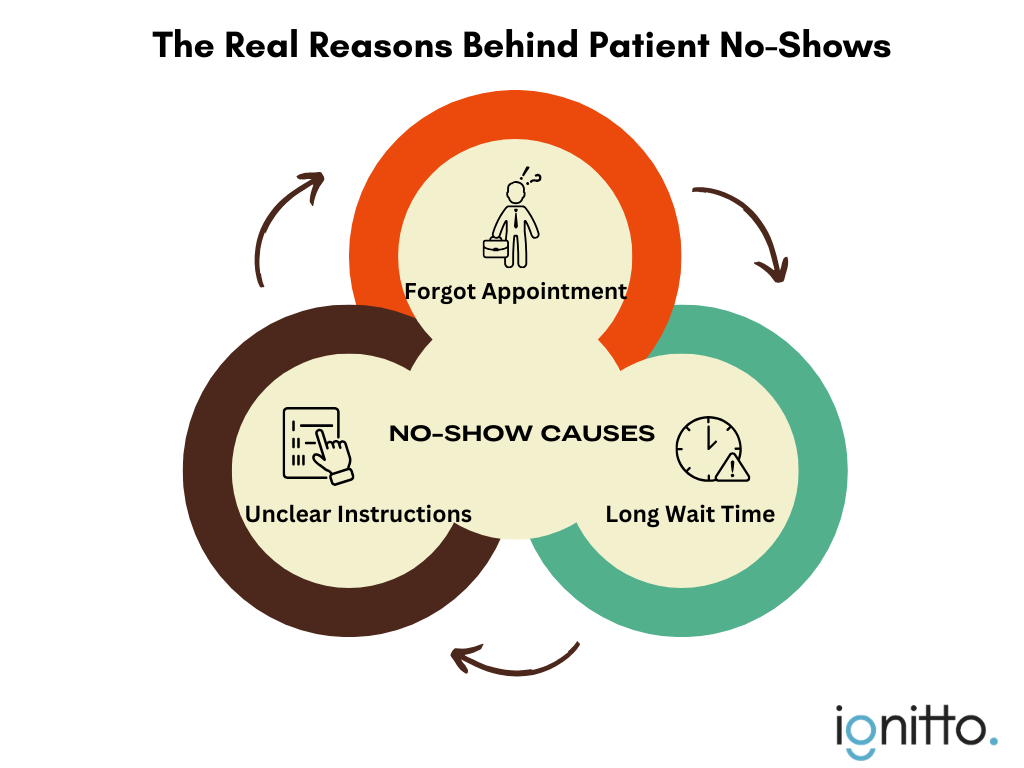
To fix patient no-shows, you need to understand why they happen. Most of the causes are simple. That means they are also easy to solve.
Forgetfulness: The Silent Revenue Killer
About one in three patients who miss an appointment say they simply forgot. They didn’t change their mind, weren’t unhappy with your clinic, they just needed a better reminder.
. This is the most common cause of patient no-shows, and it is also the easiest to fix with automation.
Lack of Clear Communication
Around 31% of patient no-shows happen because the patient felt confused or unprepared. They were unsure what to bring, what the appointment involved, or what to expect from a procedure. When patients feel anxious or uninformed, they often avoid the situation altogether. A clear, friendly pre-appointment message sequence removes that problem entirely.
Long Gaps Between Booking and Appointment
The further the appointment is from the booking date, the more likely the patient is to miss it. Motivation is highest at the moment of decision. Without regular contact between booking and appointment, that motivation fades quickly. This is especially true for high-value treatments like hair transplants, aesthetic procedures, and dental implants, where lead times tend to be long.
What Patient No-Shows Really Cost Your Clinic
Most clinics track the direct revenue loss from patient no-shows. However, that is only part of the story. The real cost goes much further.
Research shows that patients who miss a single appointment have an attrition rate of nearly 70%. Compare that to just 19% for patients who attend consistently. So a no-show does not just cost you that one slot. It significantly raises the chance that the patient never comes back at all. You lose their lifetime value, not just one visit.
Beyond that, every no-show blocks a slot that another patient could have used. Clinics with high patient no-show rates end up with reduced access for patients who actively want to book. That hurts your reviews, your reputation, and your referrals.
Finally, there is the hidden staff cost. Your team prepares the room, reviews notes, and clears the schedule. Then the patient does not arrive. That time is simply gone. In smaller practices especially, empty slots hit morale fast.
Three Things That Cut Patient No-Shows Most Effectively
The evidence on what works is clear. None of these solutions are complex. However, all of them require consistent execution, and that is where most clinics struggle.
1. Automated Reminders at the Right Time
Automated reminders are the single most effective tool for reducing patient no-shows. Send them across SMS, WhatsApp, and email, at the right moments before the appointment. A message 48 hours out, followed by one on the morning of the visit, consistently cuts missed appointments.
For example, one paediatric clinic study found that automated reminders dropped no-show rates from 38% to 23.5%. That is a 15 percentage point reduction from one system change alone. Moreover, the key is that the system runs automatically. No one on your team has to remember to send anything. It happens the same way for every patient, every time. This is exactly what Ignitto’s done-for-you marketing service builds into your clinic workflow.
2. Two-Way Confirmation
A reminder that tells a patient about their appointment is useful. A reminder that asks them to confirm is far more powerful. When patients actively reply to confirm, they feel more committed. As a result, they are far more likely to show up.
In addition, two-way confirmations give your team early warning of likely patient no-shows. If a patient does not confirm, your staff can offer the slot to someone on a waiting list. That means less revenue lost even when a cancellation does happen.
3. Pre-Appointment Education
Anxiety drives avoidance. This is especially true for elective and cosmetic procedures. A patient who booked a hair transplant consultation three months ago may have talked themselves out of it by appointment day. Consequently, sending educational content between booking and appointment keeps them informed, confident, and engaged.
An automated nurture sequence handles this entirely in the background. It answers common questions, explains what to expect, and maintains the enthusiasm the patient felt when they first booked. Your team does not write a single message manually.
Why Most Clinics Still Struggle With No-Shows
If the fixes are this clear, why do so many clinics still lose patients to no-shows? The answer is almost always the same: the solution depends on someone remembering to do it.
Your front desk team is busy. They handle calls, check-ins, admin, and payments all at once. Running a consistent reminder and follow-up sequence for every patient, every week, is simply too much to rely on manually. Even the best-intentioned teams end up with gaps. Some patients get called. Others do not.
Therefore, the only reliable fix is automation. When the system runs automatically, it works the same way for every patient, every time, with no manual effort required. That is the core idea behind the patient retention system. Ignitto builds for every clinic it works with.
How Ignitto Reduces Patient No-Shows for Clinics
Ignitto builds automated patient communication directly into your clinic’s workflow. The system connects to your booking and CRM setup via GoHighLevel. As a result, reminders, confirmations, and pre-appointment sequences go out automatically at the right time, without your team lifting a finger. This is part of Ignitto’s broaderdone-for-you marketing service for clinics, where a specialist team manages every part of patient acquisition and retention.
Clinics that add automated reminder sequences see meaningful drops in patient no-show rates within the first month. More attended appointments mean more revenue, more completed treatments, and stronger patient loyalty.
Moreover, the reminder system connects to the same platform that handles review collection, follow-up nurturing, and reactivation campaigns for lapsed patients. So when a patient attends their appointment, the system automatically requests a review at the right moment. When a patient goes quiet after treatment, a reactivation sequence brings them back. Everything works together.
Read our GoHighLevel article to explore its features, benefits, and how this powerful CRM can grow your business.
Which Clinics Benefit Most From Fixing Patient No-Shows
Reducing patient no-shows benefits every clinic. However, the return is highest where each appointment carries significant value.
- Aesthetic clinics: one missed filler or skin treatment appointment is real lost revenue. Patients who drift away rarely rebook without a targeted follow-up.
- Hair transplant clinics: consultation no-shows break the patient journey at the most critical point. Automated reminders and pre-appointment education keep patients engaged through long decision cycles.
- Dental practices: anxiety-driven procedures see the highest no-show clustering. Clear pre-appointment communication reduces avoidance and keeps chairs filled.
- Plastic surgeons: pre-operative no-shows waste significant clinical preparation time. Automated confirmations give early warning and allow slots to be reassigned quickly.
- Medical spas: repeat visits drive revenue in this category. One missed appointment, without follow-up, can break the treatment cycle entirely.
The Revenue You Are Leaving on the Table
Think of it this way. Every patient who booked and did not show up represents revenue that was already on your calendar. They were not lost to a competitor. Neither did they choose someone else. In fact, they simply needed a better system to get them through the door.
For most clinics, solving patient no-shows does not require more marketing spend or more new patients. It just means making better use of the bookings you already have. A clinic that cuts its no-show rate from 25% to 12% has effectively grown its attended appointment volume without attracting a single new patient.
That kind of efficiency changes the economics of a practice. Yet it remains one of the most overlooked opportunities in clinic marketing today.
Start Keeping More of the Appointments You Already Have
If patient no-shows are costing your clinic revenue and wasting your team’s time, the fix starts with a conversation. Book a free strategy call with the Ignitto team and find out how automated patient communication can be built into your practice alongside a complete done-for-you marketing system that keeps your appointment calendar consistently full.
Ignitto is a done-for-you marketing agency for clinics and healthcare providers. Explore their full service offering, or Book a Strategy Session to speak with the team today.
Visit our Website Iloveghl for more Articles.






Be First to Comment