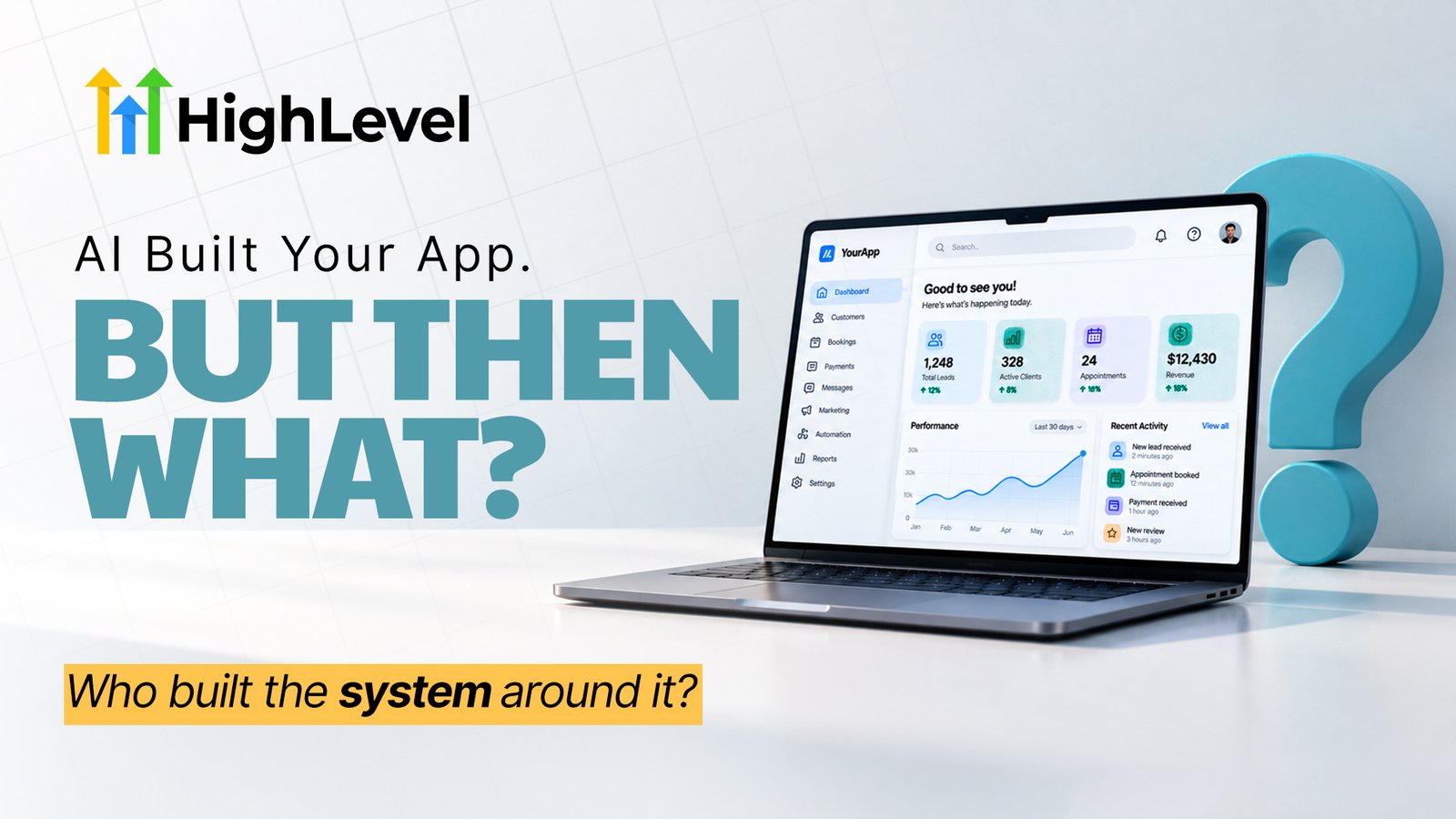
Artificial intelligence has transformed the economics of software development. Business owners can now turn ideas into capable prototypes in days instead of months, using tools like Cursor, Lovable, Bolt, Replit, and Claude to experiment faster and bring ideas to life.
This shift, often called vibe coding, is changing how businesses build technology. But creating an application is not the same as building a reliable business system.
| TL;DR 1. Vibe coding makes building apps faster, but a working prototype is not the same as a reliable business system. 2. AI can generate code, but it lacks business context around your sales process, customer journey, follow-ups, and operations. 3. Disconnected tools create unnecessary complexity, especially when your CRM, email, SMS, calendars, payments, and automations operate separately. 4. GoHighLevel brings your core growth systems together, including CRM, pipelines, communication, calendars, automation, funnels, and AI capabilities. 5. The strongest setup combines AI + automation + CRM, allowing AI to handle intelligent interactions while automation manages predictable processes. 6. Custom or vibe-coded apps can work alongside GoHighLevel, using APIs, webhooks, and workflows instead of rebuilding your entire business infrastructure. 7. The goal isn’t more software; it’s a better system. Start GoHighLevel here or book a 15-minute strategy session with Muhammad Nouman to map out the right setup for your business. |
I have spent years helping businesses implement GoHighLevel, CRM infrastructure, marketing automation, lead management systems, integrations, and AI-powered processes. One pattern has remained consistent throughout that work: technology creates value only when it supports the entire customer journey.
A beautifully designed application is useful. A connected system that helps a business capture leads, respond faster, book appointments, follow up automatically, manage customers, collect payments, and understand what is happening across the business is considerably more valuable.
That is where many AI-built applications eventually run into problems.
The Real Challenge Begins After You Build the App
Vibe coding is exceptionally good at helping you get from an idea to a prototype. You describe what you want, AI generates the code, you test it, refine the prompt, and continue until the application begins behaving the way you imagined.
For an MVP, internal tool, dashboard, calculator, portal, or proof of concept, that speed can be transformative. The challenge begins when the application moves beyond the prototype stage and becomes responsible for real customers, real data, real payments, and real business processes.
At that point, the questions become much more important.
How will the application handle a growing number of users? What happens when an external API fails? How is customer data protected? What happens when a webhook does not arrive? How will your sales team know when a new lead enters the system? Who follows up when someone submits a form but does not book an appointment? What happens after a customer pays?
These are not simply development questions. They are business system questions.
That distinction matters because a business rarely needs another isolated piece of software. It needs technology that connects marketing, sales, operations, communication, and customer experience.
Your App Should Not Become Another Disconnected Tool
One of the biggest mistakes I see businesses make is solving every new problem with another piece of software.
They have one platform for their website, another for forms, another for email marketing, another for SMS, another for calendars, another for their CRM, another for reputation management, and several automation tools trying to keep everything synchronized.
Then they build an AI application and add another system to the stack.
Eventually, nobody has a complete picture of the customer.
A lead submits a form in one platform. The sales team works from another. Appointment information lives somewhere else. Marketing emails are being sent from a separate system, while customer conversations are scattered across email, SMS, social media, and individual inboxes.
The technology may technically work, but the business becomes unnecessarily complicated.
This is one of the reasons I work extensively with GoHighLevel.
Why I Use GoHighLevel as the Operating System Behind Business Growth
GoHighLevel is not something I recommend simply because it has a long list of features. There are plenty of platforms with impressive feature lists.
I recommend it because of what happens when the core parts of a customer journey begin operating from the same system.
Instead of thinking about your CRM, pipeline, forms, calendars, email marketing, SMS, automation, reputation management, funnels, payments, and AI capabilities as completely separate tools, you can build a connected infrastructure around the customer.
Consider a simple example.
A potential customer sees your advertisement and submits a form. The lead can immediately enter your CRM, receive an automated response, be assigned to the appropriate salesperson, enter the correct pipeline, receive follow-up communication, and be directed toward booking an appointment.
When the prospect does not book, the system can continue following up.
Once the appointment is scheduled, reminders can be triggered automatically.
After the prospect becomes a customer, the opportunity can move to another stage and initiate the next part of the customer journey.
That is the difference between simply having software and having a system.
And it is where I believe businesses should focus their attention as AI makes software itself increasingly easy to create.
AI Can Generate Code. It Cannot Understand Your Business Without Context.
The biggest opportunity in AI is not replacing every tool or every person in your business. It is combining AI with well-designed processes.
An AI coding assistant can generate a webhook. It does not automatically understand what should happen operationally when that webhook fires.
It can create a contact form. It does not inherently know how your sales team should qualify the person who submits it.
It can build a dashboard. It does not know which numbers actually influence your business decisions.
It can create an AI chatbot. It does not automatically understand when that conversation should become a sales opportunity, when a human should take over, or what should happen if the prospect stops responding.
Those decisions require business context.
This is why my work with clients goes beyond simply configuring GoHighLevel or connecting software together. I look at the underlying business process first: how leads are generated, how quickly they are contacted, how they are qualified, how appointments are booked, how sales opportunities are managed, where follow-up breaks down, and which repetitive activities should be automated.
Only then does it make sense to decide what technology should handle each part of the process.
The Future Is AI + Automation + CRM
I don’t believe the future belongs to businesses that simply adopt the largest number of AI tools.
It belongs to businesses that create the best systems.
AI should handle tasks that require intelligence and dynamic decision-making. Automation should handle predictable, repetitive processes. Your CRM should maintain the central record of what is happening with every prospect and customer.
When these components work together, the result is much more powerful than any individual tool.
Imagine a new lead entering your business at 11:47 PM.
Nobody on your team is working.
Instead of waiting until the following morning, the lead receives an immediate response. AI can begin the conversation and collect relevant information. Qualified prospects can be directed toward your calendar. The conversation and contact information can be stored in the CRM. Your team arrives the next morning knowing exactly who entered the pipeline, what happened, and which opportunities require human attention.
That is not automation for the sake of automation.
It is a better operating model.
Where Vibe-Coded Applications Fit Into This
This is also where I see an enormous opportunity for businesses experimenting with vibe coding.
You do not necessarily need your AI-built application to replace your entire technology stack.
Instead, the application can solve the unique problem while platforms such as GoHighLevel manage the surrounding business infrastructure.
For example, you might build a custom calculator, assessment tool, customer portal, quoting application, AI assistant, or industry-specific interface. That application can then communicate with GoHighLevel through APIs, webhooks, workflows, and integrations.
The custom application handles what is unique to your business.
GoHighLevel handles much of the infrastructure that every growing service business needs.
This approach can significantly reduce unnecessary development while allowing you to retain the flexibility of custom software.
It is an architecture I expect we will see much more frequently as AI-assisted development matures.
You Probably Don’t Need More Software. You Need a Better System.
Before purchasing another platform or asking AI to build another application, map your customer journey.
Where do your leads come from?
Where is their information stored?
How quickly does somebody respond?
What happens when they do not reply?
How are they qualified?
How do they book?
What happens if they don’t show up?
What happens after they purchase?
How do you request reviews?
How do you reactivate old leads and customers?
Where does your team still manually copy information from one system into another?
Those answers usually reveal far more opportunities than another list of software features.
I have built my work around solving exactly these problems.
As a Certified GoHighLevel Expert and business strategist, I help businesses move beyond disconnected tools and individual automations toward systems where lead generation, CRM, sales processes, AI, marketing automation, and customer communication work together.
My role is not simply to tell a client which button to click inside GoHighLevel. It is to understand what the business is trying to accomplish, design the strategy behind the system, and then make sure the technology supports it.
Should You Use GoHighLevel?
If you operate an agency, consulting business, coaching company, local service business, or another business that depends heavily on generating leads and converting those leads into appointments and customers, GoHighLevel is worth serious consideration.
It can potentially replace several individual tools while giving you a central environment for managing leads, conversations, pipelines, calendars, marketing automation, and customer journeys.
However, software alone will not solve a broken process.
The real advantage comes from knowing what to automate, what not to automate, where AI belongs, how your pipeline should work, and how all of those pieces should connect to your actual business model.
If you want to explore the platform yourself, you can start with GoHighLevel here:
Disclosure: This is my GoHighLevel affiliate link. If you sign up through it, I may earn a commission at no additional cost to you.
Want Me to Help You Design the System?
If you already use GoHighLevel, are considering moving to it, or have built an AI-powered application and want to connect it with your marketing and sales infrastructure, the best place to start is with the business process rather than the software.
In a strategy session, we’ll review your setup, find gaps, identify automation opportunities, and map how GoHighLevel, AI, and your existing tools can work together.
You do not need another collection of disconnected automations.
You need a system designed around how your business actually operates.
Book a 15-Minute Strategy Session with Muhammad Nouman
Vibe Coding Can Build Your App Fast. But Can It Build Your Business?
Building software once required a development team, a big budget, and months of work. Today, tools like Cursor, Lovable, Bolt, Replit, and Claude let you describe an idea in plain English and build a functional application within hours.
That shift is remarkable.
Founders can validate ideas faster. Agencies can create affordable internal tools. Business owners with limited technical experience can build dashboards, calculators, portals, assessment tools, and even SaaS products.
This approach is known as vibe coding, and I believe it will fundamentally change how businesses create software.
However, there is an important distinction that gets lost in the excitement around AI development:
Building an application is becoming easier. Building a reliable business system is not.
An application can look impressive and function perfectly during a demonstration, but the real test begins when customers start using it. At that point, you are no longer dealing with buttons, pages, and prompts. You are dealing with leads, customer data, payments, sales processes, follow-ups, integrations, security, and business operations.
That is where the gap between an AI-built application and a properly designed business system becomes clear.
What Is Vibe Coding?
Vibe coding is an AI-assisted approach to software development where you describe what you want to build and allow artificial intelligence to generate much of the underlying code.
Instead of manually programming every feature, you might tell an AI development tool:
“Build me a client portal where customers can log in and see their projects.”
“Create a calculator that generates an estimate based on the information a prospect enters.”
“Build a dashboard that shows our sales performance.”
You test what the AI creates, explain what needs to change, and continue refining the application through prompts.
For prototypes and MVPs, this can be incredibly effective. It dramatically reduces the distance between having an idea and seeing that idea become something people can actually use.
The problem begins when businesses assume that because an application works, the underlying business infrastructure is also complete.
It usually isn’t.
Your App Works. What Happens Next?
Imagine you use AI to build a lead qualification application.
A prospect visits the application, enters their information, answers several questions, and receives a personalized result.
Technically, the application has done its job.
But from a business perspective, the journey has only started.
Where does that person’s information go? Does a salesperson know that a qualified lead has just arrived? Does the prospect receive an immediate response? Are they added to your CRM? Can they schedule an appointment? When they leave without booking, what happens next? After booking but missing the appointment, what happens? Once they become a customer, what happens next?
These questions have very little to do with how attractive the application looks.
They are questions about how your business operates.
This is an area I have spent years working on with businesses. As a Certified GoHighLevel Expert and business strategist, my work has involved CRM architecture, marketing automation, workflows, pipelines, lead management, AI, integrations, and the systems connecting marketing with sales and customer operations.
What I have learned is that businesses rarely suffer because they don’t have enough software.
They suffer because their software does not work together.
Most Businesses Already Have Too Many Disconnected Tools
Think about the average technology stack of a growing service business.
The website may be running on one platform. Leads are collected somewhere else. Appointments are booked using another application. Email marketing has its own software. SMS communication comes from another provider. Payments go through a separate platform. The sales team works inside a CRM, while someone is still maintaining a Google Sheet because one important piece of information never makes it into the CRM correctly.
Zapier or Make might be sitting in the middle trying to connect everything.
Now AI enters the picture.
The business adds an AI chatbot, an AI voice agent, an AI prospecting tool, an AI content platform, and potentially a custom application built with AI.
Every individual tool might be useful, but collectively they can create an increasingly fragmented business.
This is why I believe the next stage of AI adoption is not going to be about using more AI tools.
It is going to be about building better systems around them.
This Is Where GoHighLevel Becomes Interesting
One of the reasons I have continued to work extensively with GoHighLevel is that it allows businesses to bring many important parts of the customer journey into one ecosystem.
Instead of treating your CRM, pipeline, calendars, email, SMS, forms, funnels, reputation management, automation, and AI capabilities as completely separate systems, GoHighLevel gives you the infrastructure to connect them around the customer journey.
That distinction is important.
A CRM that simply stores contacts is useful.
A CRM that knows where a lead came from, automatically creates an opportunity, starts the appropriate follow-up, manages conversations, schedules appointments, triggers reminders, updates the pipeline, and initiates the next process when the lead becomes a customer is much more powerful.
Let me give you a practical example.
What a Connected Lead Journey Actually Looks Like
Imagine you run a landscaping company and spend thousands of dollars every month generating leads through Google and Meta advertising.
At 9:37 PM, a homeowner sees one of your ads and requests an estimate for a backyard renovation.
In a disconnected business, that inquiry might land in someone’s email inbox. The next morning, a salesperson sees it and makes a call. The homeowner doesn’t answer, so the salesperson leaves a voicemail.
Then the day gets busy.
Nobody follows up again.
The company paid to generate the opportunity but relied almost entirely on someone remembering what to do next.
Now imagine the same lead entering a properly designed GoHighLevel system.
The homeowner submits the form and immediately enters your CRM. The lead source is recorded, an opportunity is created in the appropriate pipeline, and the prospect receives an immediate response.
AI could begin a conversation and collect basic qualification information, such as the service required, location, estimated budget, or desired project timeline.
A qualified prospect could then be directed toward the appropriate calendar.
When they do not schedule, automated follow-up can continue.
Once they schedule, appointment confirmations and reminders can be triggered.
After a missed appointment, a no-show sequence can begin.
When the sales team starts work the following morning, they don’t need to search through inboxes and spreadsheets to understand what happened. They can see the contact, conversation, opportunity, appointment status, and next action.
That is not simply automation.
That is a business system.
AI, Automation, and CRM Should Have Different Jobs
One of the biggest mistakes businesses are making with AI is trying to use it for everything.
AI is powerful, but that doesn’t mean every business process needs an AI agent.
I prefer to think about the technology in three layers.
AI should handle intelligence. It is particularly valuable when a process requires understanding language, interpreting intent, asking dynamic questions, summarizing information, or responding based on context.
Automation should handle predictable processes. If the same action should happen every time a specific condition is met, you usually don’t need AI deciding what to do. You need a reliable workflow.
Once an appointment is booked, send a confirmation. When an appointment is missed, initiate the no-show process. After an opportunity becomes a customer, stop the sales nurture and start onboarding.
Those processes should be predictable.
Your CRM should maintain context. It should tell your team who the person is, where they came from, what conversations have happened, where they currently sit in the sales process, and what should happen next.
Put those three layers together and you have something considerably more valuable:
AI + Automation + CRM.
This is where I believe GoHighLevel becomes particularly powerful for lead-driven businesses.
Where Does Your Vibe-Coded App Fit Into This?
This is where vibe coding and GoHighLevel can complement each other rather than compete with each other.
Suppose you have built a custom application using Lovable, Cursor, Bolt, Replit, Claude, or another AI development platform.
Maybe it is an assessment tool. Perhaps it generates estimates. Maybe it is an AI-powered customer portal, quoting system, calculator, or specialized application unique to your industry.
You could try to build everything around that application yourself.
You could build your own CRM functionality, email infrastructure, SMS system, appointment scheduler, sales pipeline, follow-up engine, customer communication tools, and marketing automation.
But now you are no longer simply developing the feature that makes your application unique. You are rebuilding infrastructure that already exists.
There is another approach.
Let your custom application do what makes your business unique and let GoHighLevel manage much of the infrastructure surrounding the customer journey.
Your application can communicate with GoHighLevel through APIs, webhooks, workflows, and integrations.
When something happens inside your application, the appropriate information can be sent to your CRM and the next business process can begin.
That creates some very interesting possibilities.
Here’s a Real-World Example
Imagine you operate a financial consulting business and use AI to build a custom financial assessment.
A prospect enters information about their income, expenses, business, financial goals, and current challenges. Your custom application processes that information and generates a score.
The application has now completed its specialized task.
But instead of ending the experience there, that result can become the beginning of a customer journey.
A highly qualified prospect could automatically enter the appropriate GoHighLevel pipeline, create an opportunity, receive a personalized message, and be invited to schedule a discovery call.
Your sales team could be notified.
If the prospect doesn’t schedule, a follow-up sequence could continue the conversation.
Someone who isn’t ready for a sales conversation could instead enter an educational nurture campaign until their circumstances change.
The custom application hasn’t changed.
The difference is what happens around it.
That is strategy.
Automation Cannot Fix a Bad Business Process
There is another lesson I have learned after working extensively with GoHighLevel and automation:
You should not automate a process simply because you can.
Automation makes a good process more efficient, but it can also make a bad process happen faster.
This is why I don’t believe the right way to implement GoHighLevel is to immediately start building dozens of workflows.
Before building anything, you need to understand how the business actually operates.
Where do leads come from? How quickly should they be contacted? How are they qualified? What determines whether someone becomes an opportunity? What should happen if they stop responding? When should AI communicate with them? At what point should a human take over? What are the correct pipeline stages? What happens when the prospect becomes a customer?
Once those questions are answered, the technology becomes much easier to design.
Without that strategy, businesses often end up with dozens of workflows, complicated triggers, duplicated automations, and a CRM that nobody on the team completely trusts.
The objective should never be to create the largest automation system possible.
The objective should be to create the simplest system capable of reliably supporting the business.
Should Your Business Use GoHighLevel?
GoHighLevel is not automatically the right platform for every business.
However, if your business relies heavily on generating leads, following up with prospects, booking appointments, managing sales opportunities, communicating across multiple channels, and automating customer journeys, it deserves serious consideration.
It can be particularly valuable for agencies, consultants, coaches, local service businesses, and other organizations where leads and appointments directly influence revenue.
Rather than stitching together a collection of individual platforms, you can potentially centralize a significant part of your marketing and sales infrastructure within one ecosystem.
For agencies, the opportunity becomes even more interesting because the systems you develop can potentially be standardized and deployed across multiple clients.
This is why I don’t look at GoHighLevel as simply another CRM.
I look at it as an operating layer that can connect marketing, sales, automation, AI, communication, and customer management.
Want to Explore GoHighLevel?
If you want to see whether GoHighLevel could replace some of the disconnected tools in your business and help you build a more connected customer journey, you can explore the platform through my link below.
Start with GoHighLevel
Disclosure: This is my GoHighLevel affiliate link. If you sign up through it, I may receive a commission at no additional cost to you.
The Future Isn’t About Who Can Build an App
This is the bigger point I believe business owners need to understand.
As AI development continues improving, building software itself will become faster, cheaper, and more accessible.
The ability to create an application will become less of a competitive advantage.
The competitive advantage will be what happens after you build it.
Which company responds to leads faster?
Which company follows up consistently?
Which company has cleaner customer data?
Which sales team knows exactly where every opportunity stands?
Which company can use AI without making the customer experience feel robotic?
Which company can introduce new technology without creating operational chaos?
Which business has systems that continue working when the owner isn’t watching them?
Those are much more important questions than whether AI can generate another application.
The companies that win will not necessarily be the companies using the most AI.
They will be the companies that use AI inside the best-designed systems.
Before You Buy Another Tool, Map This
If you are considering GoHighLevel, implementing AI, or building another custom application, there is one exercise I recommend doing first.
Take your customer journey and map it from:
LEAD → CUSTOMER
Then examine everything that happens between those two points.
Where does the lead originate? Where is their information captured? What happens during the first five minutes? Who is responsible for responding? How is the prospect qualified? How do they schedule an appointment? What happens when they don’t respond? What happens if they don’t show up? How does your team manage the opportunity? What happens when they say yes? What happens after payment?
Now identify the gaps.
Some gaps can be solved with automation.
Others need AI.
A stronger CRM architecture may be the answer elsewhere.
In some cases, the solution comes down to better people or processes.
And some steps probably shouldn’t exist at all.
That is how I approach business automation.
The technology comes after understanding the business.
Build a System, Not Another Collection of Tools
I am excited about vibe coding.
I think business owners should experiment with it. Build prototypes. Test ideas. Create internal tools. Develop applications that would previously have been too expensive or time-consuming to build.
AI has given entrepreneurs extraordinary leverage.
But don’t confuse having an application with having a business system.
Your custom software is one part of a much larger customer journey. Your CRM, marketing, sales process, communication, automation, AI, and operations still need to work together.
That is where GoHighLevel can become extremely valuable.
And that is also where the right strategy matters.
Start with GoHighLevel
If you’re ready to explore how GoHighLevel can bring your CRM, marketing, automation, communication, and customer journey together, you can get started using my affiliate link:
Try GoHighLevel
I may earn a commission if you sign up through my affiliate link, at no additional cost to you.
Or Book a Discovery Call With Me
If you are already using GoHighLevel, considering moving to it, or simply aren’t sure how AI, automation, and CRM should fit together in your business, book a discovery call with me.
We can look at your current setup, understand where leads or opportunities are falling through the cracks, and identify what can realistically be improved or automated.
I don’t want to sell you another collection of tools.
I want to help you understand what the right system for your business should look like.
Book a 15-minute discovery call with Muhammad Nouman
Affiliate Disclosure
Some of the links I share may be affiliate links. If you choose to purchase or sign up through these links, I may earn a commission at no additional cost to you.
I only recommend tools and services that I believe can provide value. My opinions and recommendations remain my own, regardless of any affiliate relationship.






Be First to Comment