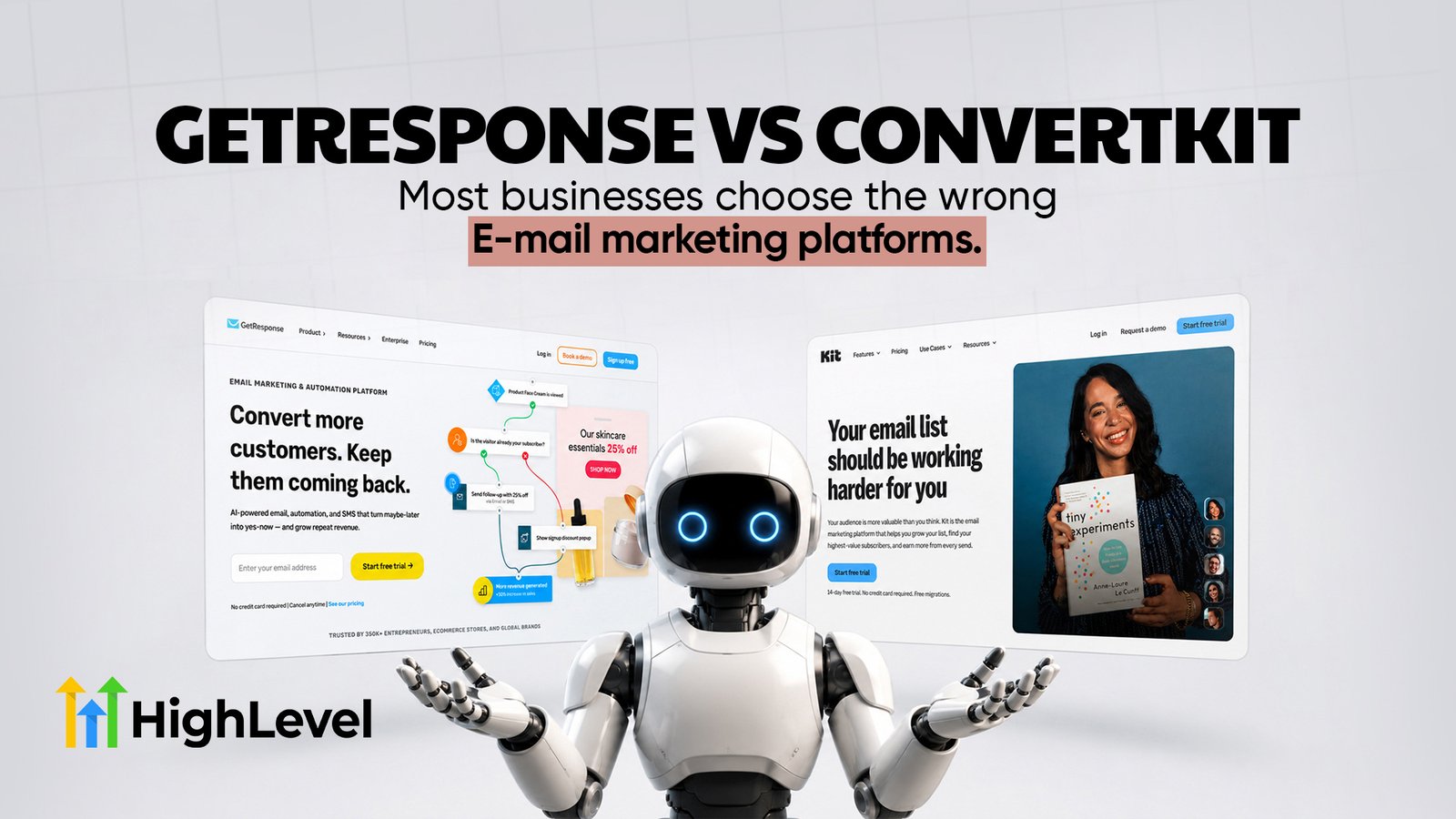
Email marketing remains one of the most effective ways to grow an online business, build long-term customer relationships, and generate consistent revenue. Unlike social media platforms, where algorithms constantly change and organic reach continues to decline, your email list is an asset you own. Every subscriber represents an opportunity to nurture trust, educate potential customers, promote products, and increase lifetime customer value. However, achieving those results depends heavily on choosing the right email marketing platform.
| TL;DR Summary 1. ConvertKit (Kit) is the overall winner for creators, coaches, consultants, educators, freelancers, and personal brands. 2. GetResponse is better suited for businesses that need webinars, ecommerce marketing, and advanced sales funnels. 3. ConvertKit offers a cleaner interface, making it much easier to learn and use on a daily basis. 4. Both platforms provide powerful email marketing, automation, landing pages, and AI tools, but ConvertKit delivers a more focused creator experience. 5. ConvertKit’s tag-based subscriber management and automation make it easier to build personalized customer journeys without unnecessary complexity. 6. Both platforms have excellent deliverability, but ConvertKit’s emphasis on relationship-based email marketing often leads to stronger engagement. 7. Need help choosing or setting up the right platform? Book a strategy call with Muhammad Nouman for expert guidance on migration, automation, and email marketing strategy. |
Among the many options available today, ConvertKit, now officially known as Kit, and GetResponse are two of the most established platforms in the industry. Both offer powerful email marketing capabilities, automation tools, landing pages, subscriber management, and integrations with hundreds of third-party applications. On paper, they appear very similar, which makes deciding between them surprisingly difficult for many business owners.
ConvertKit vs GetResponse: Built for Different Businesses
The reality is that these platforms were built with different audiences in mind. Kit was designed specifically for creators, coaches, consultants, educators, bloggers, YouTubers, authors, and businesses that grow primarily by building an audience. Every feature inside the platform focuses on helping users attract subscribers, build meaningful relationships, and monetize their expertise through newsletters, digital products, memberships, and online courses.
GetResponse takes a broader approach. Instead of concentrating on creators, it positions itself as an all-in-one marketing platform that combines email marketing with webinar hosting, landing pages, websites, conversion funnels, ecommerce marketing, and advanced automation. This makes it an attractive option for businesses looking to manage several marketing activities within a single platform.
Both are excellent products, but they excel in different areas. The best choice depends on your business model, marketing strategy, and long-term goals.
In this comprehensive comparison, we’ll examine every important aspect of both platforms, including ease of use, email creation, automation, subscriber management, landing pages, forms, artificial intelligence features, deliverability, pricing, integrations, customer support, and overall value for money. Rather than simply listing features, we’ll explain how those features affect your daily marketing activities and which platform delivers the best experience for different types of businesses.
By the end of this guide, you’ll know exactly which platform deserves your investment and why.
Quick Verdict
If you’re looking for the short answer, ConvertKit (Kit) is our overall winner.
While GetResponse offers an impressive collection of marketing tools, Kit provides a better overall experience for the majority of online businesses, especially creators, coaches, consultants, educators, agencies, freelancers, and personal brands. It focuses on what matters most: growing your audience, building relationships, and converting subscribers into loyal customers without unnecessary complexity.
One of Kit’s biggest strengths is its simplicity. The platform is remarkably easy to learn, yet powerful enough to support sophisticated email marketing strategies as your business grows. Instead of overwhelming users with dozens of features they may never use, Kit prioritizes intuitive workflows, subscriber tagging, personalized email sequences, and creator-focused monetization tools. This allows users to spend more time creating valuable content and less time learning complicated software.
GetResponse certainly has its advantages. Businesses that regularly host webinars, build advanced sales funnels, or require integrated ecommerce marketing may appreciate its broader feature set. However, for most businesses, many of those additional tools remain unused while adding unnecessary complexity to the platform.
If your primary goal is building an engaged email list, nurturing subscribers, selling digital products or services, and creating a sustainable online business, ConvertKit delivers the better balance of simplicity, flexibility, and long-term value.
ConvertKit vs GetResponse at a Glance
| Feature | ConvertKit (Kit) | GetResponse |
| Ease of Use | Excellent | Very Good |
| Email Marketing | Excellent | Excellent |
| Automation | Excellent | Excellent |
| Subscriber Tagging | Excellent | Very Good |
| Landing Pages | Excellent | Excellent |
| Signup Forms | Excellent | Excellent |
| Digital Product Sales | Native | Via Integrations |
| Paid Newsletters | Yes | No |
| Webinar Hosting | No | Yes |
| Conversion Funnels | Basic | Advanced |
| AI Writing Tools | Yes | Yes |
| Ecommerce Features | Good | Excellent |
| Deliverability | Excellent | Very Good |
| Best For | Creators & Personal Brands | Businesses & Ecommerce |
Although this comparison table provides a useful overview, choosing an email marketing platform involves much more than comparing feature lists. The real difference lies in how each platform approaches email marketing and the type of user it was designed to serve.
What Is ConvertKit (Kit)?
ConvertKit, recently rebranded as Kit, is an email marketing platform created specifically for creators. Unlike traditional marketing software that attempts to serve every type of business, Kit focuses almost entirely on helping people build audiences and monetize their knowledge.
Since its launch, the platform has become one of the most trusted solutions for bloggers, YouTubers, podcasters, authors, coaches, consultants, online educators, newsletter publishers, and digital entrepreneurs. Rather than overwhelming users with enterprise-level marketing features, Kit concentrates on helping creators grow their subscriber lists, automate email communication, segment audiences using tags, sell digital products, and build long-term relationships with subscribers.
One of the reasons Kit has become so popular is its philosophy around email marketing. Instead of encouraging highly designed promotional emails, the platform emphasizes clean, personal communication. Many creators have found that conversational emails often outperform heavily designed marketing campaigns because they feel more authentic and generate higher engagement.
Another major advantage is Kit’s native creator commerce features. Users can sell digital downloads, paid newsletters, memberships, and other digital products directly through the platform without relying on several third-party tools. This streamlined approach makes Kit particularly attractive for creators who want to spend less time managing technology and more time producing valuable content.
What Is GetResponse?
GetResponse began as an email marketing platform but has evolved into a comprehensive marketing solution for businesses. Over the years, it has expanded far beyond newsletters by introducing landing page builders, website creation tools, webinar hosting, sales funnels, ecommerce marketing, and advanced automation capabilities.
Its primary audience includes small businesses, marketing agencies, ecommerce companies, SaaS businesses, and organizations that require multiple marketing tools working together inside a single platform.
Businesses using GetResponse can attract leads through landing pages, automate follow-up sequences, host webinars, recover abandoned shopping carts, build conversion funnels, and monitor campaign performance without purchasing separate software for each activity.
This broader functionality makes GetResponse particularly attractive for businesses with larger marketing teams or more complex customer journeys. However, the additional capabilities also make the platform more feature-rich and slightly more challenging for beginners compared to Kit.
Who Should Choose ConvertKit?
ConvertKit is an outstanding choice for businesses that rely on audience building as their primary growth strategy. If your customers discover you through blog articles, YouTube videos, podcasts, social media content, online communities, newsletters, or educational resources, Kit was designed specifically for your business model.
It is especially well suited for creators who sell online courses, coaching programs, consulting services, memberships, digital downloads, templates, ebooks, or premium newsletters. The platform makes it incredibly easy to capture leads, nurture subscribers through personalized email sequences, segment audiences based on interests and behavior, and present relevant offers at the right time.
Its straightforward interface also makes it an excellent choice for entrepreneurs who want powerful email marketing without spending weeks learning complicated software. Beginners can launch campaigns quickly, while experienced marketers still have access to sophisticated automation and segmentation capabilities as their businesses grow.
Overall Winner (So Far): ConvertKit
After evaluating the overall philosophy, target audience, user experience, and long-term value of both platforms, ConvertKit takes the early lead.
Although GetResponse includes more marketing tools, ConvertKit focuses on helping users succeed at what matters most: building an audience, creating meaningful relationships, and generating revenue through email marketing. Its creator-first approach, intuitive interface, excellent automation, and native monetization features make it the stronger choice for most creators and service-based businesses.
If you’re ready to start building your email list with ConvertKit, you can support my work by signing up through my affiliate link. You’ll pay the same price, while helping support the creation of detailed comparison guides like this one.
Not sure whether ConvertKit or GetResponse is right for your business?
Book a strategy call with Muhammad Nouman. As an email marketing and marketing automation consultant, I can help you choose the right platform, migrate your subscribers, build high-converting automation workflows, create landing pages, and set up a complete email marketing system tailored to your business goals.
Ease of Use: Which Platform Is Easier to Learn?
When choosing an email marketing platform, features are important, but usability is equally critical. The most powerful automation builder or the most advanced reporting dashboard becomes meaningless if you struggle to use it every day. Your email marketing software should help you work faster, not create additional complexity.
This is one area where ConvertKit immediately stands out.
ConvertKit is designed for simplicity, with a clean dashboard and intuitive navigation. Its straightforward interface makes it easy to create email campaigns, automations, landing pages, and opt-in forms without unnecessary complexity.
Instead of trying to become a complete marketing operating system, ConvertKit concentrates on helping users perform email marketing exceptionally well. Every menu, button, and workflow has been carefully designed around how creators actually build and engage their audiences.
For someone launching their first newsletter or online business, this simplicity is invaluable. You can begin collecting subscribers and sending automated emails within minutes instead of spending days learning complicated software.
GetResponse takes a different approach.
Because it includes website building, webinar hosting, conversion funnels, ecommerce marketing, paid ads, landing pages, AI tools, and many additional features, the interface naturally becomes more complex. The dashboard contains significantly more menus and settings than ConvertKit. While experienced marketers may appreciate having everything available in one place, beginners often need considerably more time before they feel comfortable navigating the platform.
This doesn’t mean GetResponse has a poor user experience. On the contrary, it is well designed considering the number of features it offers. However, there is simply more to learn.
As your business grows, simplicity often becomes an advantage rather than a limitation. Instead of constantly searching through menus or configuring dozens of settings, ConvertKit allows you to focus on writing better emails, creating valuable content, and building stronger relationships with your audience.
Winner: ConvertKit
For creators, coaches, consultants, freelancers, educators, and small business owners who value speed and simplicity, ConvertKit provides one of the easiest learning experiences in the email marketing industry.
Email Builder: Writing Emails That People Actually Read
The quality of your emails matters far more than how colorful they look. An email that feels personal often outperforms one filled with graphics, banners, and complicated layouts.
ConvertKit understands this philosophy better than almost any other platform.
Its email editor intentionally encourages conversational communication. Instead of opening dozens of design options and hundreds of templates, you’re presented with a clean writing environment that feels remarkably similar to writing inside a document editor. You can add images, buttons, personalization tags, countdown timers, product links, and formatting when necessary, but the primary emphasis remains on your message rather than decorative design.
This approach has become increasingly popular among successful newsletter creators because subscribers often respond more positively to emails that resemble personal conversations rather than promotional advertisements.
Many of today’s highest-performing newsletters use simple formatting for exactly this reason. The email feels authentic, trustworthy, and written specifically for the reader.
GetResponse approaches email design differently.
It provides a drag-and-drop email builder with a large collection of professionally designed templates. Users can create multi-column layouts, insert product showcases, build promotional banners, add countdown timers, include videos, and customize nearly every visual element.
For ecommerce brands running promotional campaigns or businesses with strict brand guidelines, these design capabilities are certainly valuable.
However, more design flexibility also introduces additional complexity. Creating highly designed emails usually takes longer, and inexperienced marketers sometimes focus more on appearance than writing compelling copy that actually converts.
For most creators and service businesses, the simpler writing experience inside ConvertKit often leads to better communication and stronger subscriber engagement.
Winner: ConvertKit
While GetResponse offers more visual customization, ConvertKit’s editor encourages the type of authentic email communication that consistently produces higher engagement and stronger relationships with subscribers.
Email Templates
Email templates can save time, especially for businesses that frequently send promotional campaigns. However, they are not always the deciding factor when choosing an email marketing platform.
GetResponse offers one of the larger template libraries in the email marketing industry. Businesses can choose from professionally designed templates covering ecommerce promotions, holiday campaigns, newsletters, product launches, event invitations, announcements, seasonal sales, and many other use cases. These templates can be customized using the drag-and-drop editor, making it relatively easy to create visually polished campaigns.
ConvertKit takes a different approach.
Rather than overwhelming users with hundreds of templates, it focuses on a smaller collection of clean, modern layouts optimized for readability. The philosophy behind ConvertKit is that subscribers join your email list because they value your content, not because they expect beautifully designed marketing emails.
This creator-first mindset encourages users to invest more effort into writing valuable content instead of spending excessive time designing emails.
For many businesses, this ultimately leads to stronger engagement because the emphasis remains on communication rather than decoration.
Winner: ConvertKit
Less can sometimes accomplish more. ConvertKit’s minimalist approach helps creators produce authentic emails that readers actually enjoy opening.
Landing Pages
Landing pages play an essential role in growing your email list. Whether you’re offering a lead magnet, promoting a webinar, launching a newsletter, or selling a digital product, an optimized landing page can significantly increase your conversion rate.
Both ConvertKit and GetResponse include landing page builders, but they target different audiences.
ConvertKit’s landing page builder is designed around lead generation. Creating a landing page requires very little technical knowledge, and the available templates are optimized specifically for collecting email subscribers. Users can quickly customize headlines, images, branding, colors, forms, and calls to action before publishing their pages.
Because the landing page builder integrates directly with ConvertKit’s subscriber management and automation system, every new subscriber can immediately enter an automated email sequence without requiring additional configuration.
For creators launching newsletters, ebooks, coaching programs, online courses, podcasts, or YouTube lead magnets, ConvertKit’s landing pages provide everything needed to begin growing an audience quickly.
GetResponse offers a more advanced landing page builder.
Businesses have access to additional design flexibility, A/B testing options, ecommerce blocks, sales pages, webinar registration pages, and broader customization capabilities.
For larger businesses running paid advertising campaigns or complex sales funnels, these additional features can certainly be beneficial.
However, many creators simply need an attractive page that converts visitors into subscribers. In those situations, ConvertKit’s streamlined approach often produces faster results while remaining considerably easier to manage.
Winner: ConvertKit
For audience growth, newsletter subscriptions, lead magnets, and creator businesses, ConvertKit offers the better balance of simplicity, speed, and conversion-focused design.
Signup Forms
Every successful email marketing strategy begins with collecting subscribers.
ConvertKit makes creating signup forms remarkably straightforward. Forms can be embedded into websites, blog posts, landing pages, and ecommerce stores within minutes. Users can customize colors, layouts, branding, and fields while automatically connecting subscribers to specific tags, sequences, or automation workflows.
This direct integration significantly reduces manual work. Every subscriber immediately enters the correct automation based on how they joined your list.
GetResponse also provides customizable signup forms with popups, embedded forms, exit-intent forms, and integrations for websites.
Its customization options are broader, but they also introduce additional configuration requirements.
For businesses simply looking to grow an engaged email list, ConvertKit delivers a faster and cleaner experience.
Winner: ConvertKit
ConvertKit removes unnecessary friction from the subscriber signup process while providing powerful automation immediately after someone joins your list.
Subscriber Management and Segmentation
One of ConvertKit’s greatest strengths has always been subscriber management.
Unlike traditional email marketing platforms that organize people into multiple disconnected lists, ConvertKit maintains a single subscriber database enhanced through tags and segments.
This approach prevents duplicate subscribers, keeps your database organized, and allows you to build highly personalized email experiences.
For example, someone who downloads your free ebook, purchases your online course, attends your webinar, and joins your newsletter remains a single subscriber with multiple tags rather than appearing several times across different lists.
As your audience grows into the thousands or even hundreds of thousands, this system becomes significantly easier to manage.
You can segment subscribers based on interests, purchases, engagement, custom fields, location, referral source, or virtually any other criteria.
GetResponse also provides advanced segmentation capabilities, including behavioral segmentation, ecommerce activity, purchase history, lead scoring, and automation triggers.
It is an excellent system for businesses running sophisticated marketing campaigns.
However, ConvertKit’s tagging philosophy is easier to understand and significantly more intuitive for creators and service businesses. Managing subscribers feels natural rather than technical.
Winner: ConvertKit
Its tag-based subscriber management remains one of the strongest reasons creators continue choosing ConvertKit year after year.
After comparing usability, email creation, templates, landing pages, forms, and subscriber management, ConvertKit continues to strengthen its lead.
While GetResponse undoubtedly offers more design flexibility and additional marketing tools, ConvertKit consistently delivers a faster, simpler, and more focused experience for the people who rely on email marketing the most. Its clean interface, creator-first philosophy, intuitive subscriber management, and emphasis on meaningful communication make it the better platform for building long-term relationships with your audience.
If your goal is to grow a newsletter, sell digital products, nurture leads, or build a personal brand, ConvertKit provides nearly everything you need without the unnecessary complexity found in larger marketing platforms.
Ready to get started? Sign up for ConvertKit using my affiliate link and begin building your audience with one of the best creator-focused email marketing platforms available today.
Need help setting everything up? Book a strategy call with Muhammad Nouman. I can help you migrate from another platform, build your email automation, create high-converting landing pages, optimize your subscriber journey, and ensure your ConvertKit account is set up for long-term success.
Marketing Automation: Which Platform Helps You Save More Time?
Marketing automation is one of the biggest reasons businesses invest in email marketing software. Instead of manually sending emails every time someone joins your newsletter, downloads a lead magnet, purchases a product, or books a consultation, automation allows those actions to happen automatically. A well-designed automation system saves hours of repetitive work while ensuring every subscriber receives the right message at the right time.
Both ConvertKit and GetResponse offer visual automation builders, but they approach automation from different perspectives. ConvertKit focuses on making automation simple, intuitive, and creator-friendly, while GetResponse offers a broader range of automation capabilities designed for businesses running complex marketing campaigns.
For most creators and service-based businesses, ConvertKit strikes the better balance between power and simplicity.
ConvertKit Marketing Automation
ConvertKit’s automation builder is built around how creators naturally communicate with their audiences. Instead of creating complicated workflows filled with dozens of decision points, users can build subscriber journeys using visual triggers, actions, and conditions that are easy to understand.
A subscriber might join your newsletter through a landing page, download a free guide, purchase a digital product, or click a particular link inside an email. Based on those actions, ConvertKit can automatically apply tags, start an email sequence, remove subscribers from another sequence, update custom fields, or move subscribers into a completely different customer journey.
Everything happens visually, making it easy to understand how subscribers move through your marketing funnel.
For example, imagine you’re a business coach offering a free productivity guide. A visitor downloads your guide from a landing page. ConvertKit immediately tags that subscriber as “Productivity Lead,” sends a welcome email, delivers the download link, follows up with educational emails over the next several days, shares success stories from previous clients, and eventually invites the subscriber to book a strategy call. If the subscriber books a consultation or purchases your coaching program, ConvertKit automatically removes them from the sales sequence and places them into your customer onboarding sequence.
This type of automation requires very little technical knowledge to build inside ConvertKit, making it ideal for creators who want sophisticated marketing without unnecessary complexity.
GetResponse Marketing Automation
GetResponse also provides an impressive automation builder with significantly more workflow possibilities. Businesses can automate emails based on subscriber behavior, ecommerce purchases, website visits, webinar registrations, abandoned shopping carts, lead scores, and numerous other conditions.
Its automation builder includes advanced branching logic, allowing marketers to create highly customized customer journeys across multiple channels. Depending on the pricing plan, businesses can also combine email marketing with SMS campaigns, web push notifications, webinars, and ecommerce automation within the same workflow.
These capabilities make GetResponse particularly attractive for larger organizations managing complex customer journeys involving multiple products, multiple sales teams, and several marketing channels.
However, with greater flexibility comes greater complexity.
Many small businesses and creators never utilize the majority of these advanced automation features. Instead, they often spend more time learning the platform than actually building relationships with their subscribers.
Which Automation Platform Is Better?
If your business depends on complicated ecommerce workflows, enterprise-level customer journeys, or advanced behavioral marketing, GetResponse certainly provides more automation possibilities.
However, for the majority of creators, consultants, coaches, agencies, educators, freelancers, and service businesses, ConvertKit delivers everything needed to build highly effective email automation while remaining significantly easier to use.
The beauty of ConvertKit lies in its simplicity. It removes unnecessary technical barriers without sacrificing the automation features that genuinely improve your marketing performance.
Winner: ConvertKit
Subscriber Tagging and Audience Segmentation
Sending the same email to every subscriber is rarely an effective marketing strategy. Some subscribers may have already purchased your products, while others are still discovering your business. Some may be interested in one topic, while others joined your list for entirely different reasons.
Audience segmentation allows you to send more relevant emails, resulting in higher open rates, better click-through rates, stronger engagement, and increased sales.
This is another area where ConvertKit has built an outstanding reputation.
Unlike many traditional email marketing platforms that organize subscribers into separate lists, ConvertKit operates around a single subscriber database enhanced through tags and segments. Every subscriber exists only once inside your account, regardless of how many forms they complete or products they purchase.
As subscribers interact with your business, ConvertKit simply adds additional tags that describe their interests and behavior.
For example, a subscriber may receive tags such as:
- Newsletter Subscriber
- Downloaded Free Guide
- Webinar Attendee
- Purchased Course
- Coaching Client
- VIP Customer
This structure makes audience management incredibly simple. Instead of worrying about duplicate subscribers across multiple lists, you simply filter subscribers based on their tags and send highly personalized campaigns.
The tagging system also integrates seamlessly with ConvertKit’s automation builder. Every action a subscriber takes can automatically trigger new tags, remove old ones, or start entirely new automation sequences.
GetResponse also supports audience segmentation, offering conditions based on demographics, purchase history, campaign engagement, ecommerce activity, and subscriber behavior.
Its segmentation capabilities are powerful, especially for ecommerce businesses running detailed marketing campaigns.
However, ConvertKit’s tagging philosophy remains easier to understand and significantly more intuitive for creators. As subscriber lists grow into the tens or even hundreds of thousands, keeping everything organized becomes remarkably straightforward.
For businesses focused on relationship marketing, ConvertKit’s tagging system is one of its strongest competitive advantages.
Winner: ConvertKit
Artificial Intelligence Features
Artificial intelligence has quickly become an important part of modern email marketing. AI can help marketers generate subject lines, improve email copy, create landing page content, analyze campaign performance, and optimize customer engagement.
Both ConvertKit and GetResponse have invested in AI capabilities, although they use artificial intelligence differently.
ConvertKit focuses on helping creators write better emails faster. Its AI writing assistant can generate subject lines, improve existing content, overcome writer’s block, and help users create engaging newsletters more efficiently. Rather than replacing the creator’s voice, the AI serves as a writing assistant that accelerates content creation while preserving authenticity.
For creators who regularly publish newsletters, this feature can save a significant amount of time without compromising the personal tone that subscribers expect.
GetResponse has expanded AI beyond email writing. The platform includes AI tools for generating emails, designing landing pages, building websites, and assisting with marketing content creation. Businesses looking for broader AI support across multiple marketing activities may appreciate these additional capabilities.
Nevertheless, AI should always complement a strong marketing strategy rather than replace it.
The quality of your messaging, your understanding of your audience, and the value you provide will always have a greater impact than any AI-generated content.
ConvertKit succeeds because its AI tools enhance the creator’s workflow instead of attempting to automate the entire creative process.
Winner: ConvertKit
Email Deliverability
Even the most beautifully written email has no value if it never reaches your subscriber’s inbox.
Email deliverability measures how successfully your emails avoid spam folders and reach the primary inbox where subscribers actually see them. Factors such as sender reputation, list quality, authentication, subscriber engagement, and email content all influence deliverability.
Both ConvertKit and GetResponse maintain strong reputations for email deliverability and follow industry best practices to help users achieve reliable inbox placement.
ConvertKit has earned particular praise among creators because its platform naturally encourages healthier email marketing practices. Since most users send clean, conversational emails instead of image-heavy promotional campaigns, subscriber engagement tends to remain high. Higher engagement signals positively to email providers, improving long-term deliverability.
The platform also encourages proper list management by making it easy to identify inactive subscribers, remove unengaged contacts, and maintain a healthy sender reputation.
GetResponse likewise performs well in deliverability testing and provides authentication options, reputation monitoring, and additional tools for businesses managing larger email volumes.
In practical terms, both platforms deliver excellent results when used correctly.
However, ConvertKit’s creator-focused approach naturally encourages the type of email communication that performs exceptionally well over the long term.
For creators, educators, coaches, consultants, and personal brands, this often translates into higher open rates and stronger subscriber engagement.
Winner: ConvertKit
Integrations
No email marketing platform operates in isolation. Most businesses rely on websites, ecommerce stores, payment processors, online course platforms, CRM systems, scheduling software, and countless other applications.
ConvertKit integrates with hundreds of popular tools, including website builders, ecommerce platforms, membership systems, payment gateways, course platforms, webinar software, and automation services. Whether you use WordPress, Shopify, Stripe, Zapier, Make, or many other popular applications, connecting your existing tools is typically straightforward.
One area where ConvertKit excels is its integration with creator-focused platforms. Businesses selling online courses, digital downloads, coaching programs, memberships, and newsletters will find that many of their favorite tools already integrate seamlessly with ConvertKit.
GetResponse also supports a large integration ecosystem covering ecommerce platforms, CRM software, webinar tools, advertising platforms, payment gateways, analytics software, and business applications.
Both platforms perform well here, but ConvertKit’s ecosystem is particularly attractive for businesses built around content creation and audience growth.
Winner: ConvertKit
If you’re planning to build a long-term email marketing system, selecting the right platform from the beginning can save countless hours of migration work later. As a Certified Marketing Automation Consultant, I help businesses choose the right platform, migrate existing subscribers, build automation workflows, create lead magnets, develop email sequences, and optimize marketing performance. If you’re unsure whether ConvertKit is the right fit for your business, book a strategy call with Muhammad Nouman, and I’ll help you build an email marketing system that supports your long-term growth. When you’re ready to get started, you can also support my work by signing up for ConvertKit using my affiliate link.
Conclusion
Both ConvertKit (Kit) and GetResponse are excellent email marketing platforms, but they serve different types of businesses. GetResponse stands out if you need advanced webinar hosting, ecommerce tools, and comprehensive marketing funnels all within one platform. However, if your primary goal is to grow an audience, build meaningful relationships through email, sell digital products or services, and create sustainable long-term revenue, ConvertKit is the stronger choice. Its intuitive interface, powerful automation, creator-focused features, and excellent deliverability make it an outstanding investment for creators, coaches, consultants, educators, agencies, and personal brands.
Ultimately, the best email marketing platform is the one that aligns with your business model and growth strategy. If you’re ready to build a high-performing email marketing system, I recommend signing up for ConvertKit using my affiliate link. If you need help migrating from another platform, creating automation workflows, building landing pages, or developing an email marketing strategy that generates consistent leads and sales, book a strategy call with Muhammad Nouman. As a marketing automation consultant, I can help you implement a system that supports your business today and scales with you in the future.
Affiliate Disclosure
This article contains affiliate links. If you sign up through my affiliate link, I may earn a commission at no additional cost to you. I only recommend tools that I genuinely believe provide value and would confidently use for my own business.






Be First to Comment