Google Ads for clinics should be the fastest way to bring in new patients. Set up correctly, they put your clinic at the top of search results the same day you switch them on. Done wrong, they drain your budget every month and deliver almost nothing.
| TL;DR Summary Google Ads for clinics can be one of the fastest ways to generate new patient enquiries, but only when campaigns are set up and managed correctly. Most clinics waste budget on broad keywords, poor landing pages, missing tracking, and lack of ongoing optimisation, which leads to clicks without bookings. High-performing campaigns focus on high-intent, location-specific keywords, dedicated landing pages, and full conversion tracking. When combined with review management and follow-up systems, Google Ads becomes a consistent and scalable source of new patients. The difference between success and wasted spend is not the platform, it is the strategy behind it. If you want to see where your current campaigns are going wrong, you can Book a free strategy session to get a clear plan for fixing them. |
Most clinics fall into the second camp. They run Google Ads, spend a few thousand a month, and get a handful of calls that rarely turn into booked appointments. So they either cut the budget or keep spending without understanding why it is not working.
The problem is almost never the platform. Google Ads works very well for clinics that set it up the right way. The problem is how most practices run their campaigns. If you want to find out what is going wrong in your specific clinic, Book a free strategy session with the Ignitto team and get a clear picture of exactly where your budget is going.
This article explains why Google Ads for clinics fails so often in 2026, what the most common mistakes look like, and how a properly managed campaign can become your most reliable source of new patients.
Why Google Ads for Clinics Is Such a Big Opportunity
First, let us be clear about the scale of the opportunity. Patients search for clinics on Google millions of times every day. They type in things like “hair transplant clinic near me,” “best aesthetic clinic in Dubai,” or “dental implants cost.” These are high-intent searches. The patient is not browsing. They are ready to book.
Google Ads puts your clinic in front of those patients at the exact moment they are looking. Furthermore, you only pay when someone clicks. That means every pound or dollar you spend goes toward someone who has already shown interest in what you offer.
For that reason, Google Ads for clinics has one of the highest returns of any marketing channel when it runs correctly. However, the keyword here is correct. The gap between a well-run campaign and a poorly run one is enormous, and most clinics sit firmly on the wrong side of that gap.
The Five Mistakes That Waste Your Google Ads Budget
In most cases, wasted clinic ad spend comes down to the same handful of mistakes. Spotting them is the first step to fixing them.
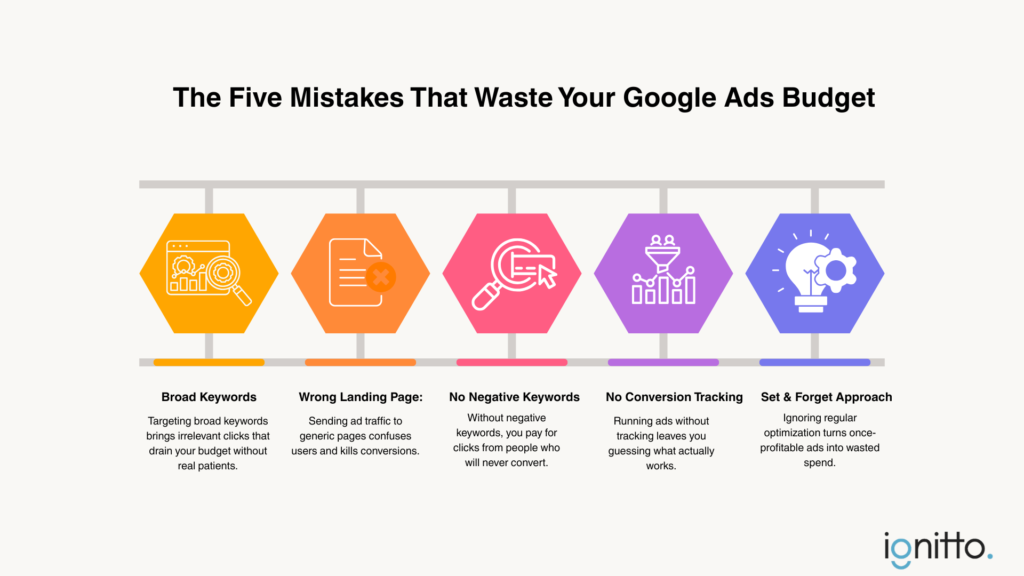
1. Targeting Keywords That Are Too Broad
Broad keywords attract the wrong people. If your clinic runs Google Ads targeting the word “hair loss,” your ad shows to everyone who types that phrase. That includes people looking for shampoo, people reading articles, and students doing research. Very few of them want a clinic consultation.
Consequently, your budget disappears fast. You pay for dozens of irrelevant clicks and get almost no bookings in return. The fix is to use specific, high-intent keywords. Phrases like “hair transplant clinic in Riyadh” or “FUE hair transplant cost” attract people who are actively looking for a provider. These clicks cost more per click but convert at a far higher rate.
2. Sending Clicks to the Wrong Page
Many clinics send paid traffic straight to their homepage. That is a costly mistake. A patient who clicks an ad for a lip filler treatment and lands on a homepage full of general information will leave within seconds.
Instead, every Google Ads campaign needs a dedicated landing page. That page should match the ad exactly. It should explain the treatment, show social proof, and give the patient one clear action to take: book a consultation. As a result, conversion rates rise sharply. More clicks turn into actual booked appointments.
3. Ignoring Negative Keywords
Negative keywords are terms you tell Google not to show your ads for. Most clinics skip this step entirely. That means their ads appear for searches that have nothing to do with their services.
For example, an aesthetic clinic without negative keywords might show ads to people searching “DIY filler at home” or “filler gone wrong.” These clicks cost money and never convert. Building a strong negative keyword list is one of the quickest ways to cut wasted spend and improve campaign performance immediately.
4. Running Ads Without Tracking Conversions
Surprisingly, many clinics run Google Ads without tracking what happens after someone clicks. They know how much they spend, but they have no idea how many calls, form submissions, or bookings came from their ads.
Without that data, it is impossible to improve. You cannot tell which keywords work, which ads perform best, or which landing pages convert. Therefore, setting up conversion tracking before launching any campaign is essential. It turns your ad account from a guessing game into a system you can actually manage and improve.
5. Setting It Up Once and Walking Away
Google Ads is not a set-and-forget tool. The platform changes, competitors adjust their bids, and search trends shift. A campaign that performed well six months ago may be bleeding money today if nobody has touched it.
Effective Google Ads for clinics requires regular management. That means reviewing search term reports weekly, testing new ad copy, adjusting bids, and refining targeting based on real performance data. This is precisely why most clinics get better results when they work with a team that manages campaigns daily, rather than checking in once a month.
What a High-Performing Google Ads Campaign Looks Like
A well-run Google Ads campaign for a clinic has a clear structure. Each part works together to turn a search into a booked appointment.
To begin with, the keyword strategy focuses on treatment-specific, location-specific terms. It avoids broad terms and targets phrases that signal intent to book. The campaign uses match types carefully to stay in control of which searches trigger the ads.
Next, each ad group has its own landing page. The page matches the ad copy exactly. It loads fast on mobile, shows patient reviews, answers common objections, and has a single clear call to action. There are no distractions and no extra navigation.
In addition, conversion tracking covers every meaningful action. Phone calls, form fills, WhatsApp messages, and booking completions all feed back into the ad account. That data drives every decision about where to spend more and where to cut.
Finally, the campaign runs alongside a remarketing strategy. Patients who clicked but did not book see follow-up ads on other websites and platforms. That keeps your clinic front of mind until they are ready to take action. Together, these elements make Google Ads for clinics a consistent, scalable source of new patient enquiries.
How Google Ads for Clinics Fits Into a Full Marketing System
Google Ads is a powerful tool. However, it works best as part of a wider patient acquisition system, not as a standalone channel.
For instance, a patient clicks your ad and lands on your page. Before they book, most of them check your Google profile. If your reviews are strong, they book. If your reviews are thin, they leave. That means your Google review profile directly affects how well your paid ads convert. A strong reputation turns ad clicks into booked appointments. A weak one wastes the spend.
Similarly, your Google Business Profile supports your paid campaign. A complete, active profile with recent reviews and up-to-date information reinforces the credibility your ad creates. Patients who click an ad and then see a well-maintained Google profile feel more confident. Consequently, they are far more likely to book.
Beyond that, retargeting campaigns, email follow-ups, and WhatsApp sequences keep patients engaged after the initial click. Without those follow-up systems, you lose a large share of the patients who showed interest but were not ready to book immediately. With them, you recover a significant portion of that lost revenue.
This is the system that Ignitto builds for every clinic it works with. Google Ads runs alongside reputation management, follow-up automation, and patient nurture sequences. Every channel supports the next. Nothing is left to chance.
Which Clinics Get the Best Results From Google Ads
Google Ads for clinics works across all specialties. However, the return is especially strong in practices where patients search with clear intent before booking a high-value treatment.
- Hair transplant clinics: patients search for procedures by name and location before booking. High-intent keywords convert well, and the value of each consultation makes the cost per click very manageable.
- Aesthetic clinics: treatments like lip fillers, anti-wrinkle injections, and body contouring attract consistent search volume. Targeted campaigns by treatment type produce strong conversion rates.
- Dental practices: implants, Invisalign, and cosmetic dentistry procedures generate significant paid search volume. Patients compare providers before booking, so appearing at the top of results is critical.
- Plastic surgeons: high-value procedures mean even a single booked consultation justifies a significant ad spend. Precise targeting and strong landing pages make the economics of paid search work extremely well.
- Dermatologists: local search drives most new patient enquiries. Google Ads fills the gaps that organic search rankings take months to reach.
- Medical spas: treatment-specific campaigns, especially for laser, skin, and body treatments, attract ready-to-book patients at scale.
The Cost of Running Google Ads Without a Strategy
Every month a clinic runs poorly managed Google Ads, it pays for clicks that go nowhere. Those are not small numbers. A clinic spending $3,000 a month on Google Ads with a 2% conversion rate gets around 60 enquiries. Raise that conversion rate to 6% with better targeting and landing pages, and the same budget delivers 180 enquiries. That is three times the output for the same cost.
Moreover, the compounding effect goes further. Better campaigns improve your quality score in Google’s system. A higher quality score lowers your cost per click over time. So a well-managed campaign gets cheaper and more effective the longer it runs, while a poorly managed one stays expensive and delivers diminishing returns.
In short, the gap between a good campaign and a bad one is not just performance. It is the total economics of your practice’s growth. Google Ads for clinics, done right, is one of the most cost-effective ways to grow a patient list. Done wrong, it is one of the most expensive ways to generate nothing.
How Ignitto Manages Google Ads for Clinics
Ignitto runs Google Ads as part of its done-for-you marketing service for clinics. The team handles everything: keyword research, ad copy, landing page setup, conversion tracking, bid management, and ongoing optimisation. Nothing is set up and left running. Every campaign gets active weekly management from a specialist team that works exclusively with clinics and healthcare providers.
Furthermore, every Google Ads campaign connects directly to the wider Ignitto system. Review requests go out automatically after each appointment. Follow-up sequences re-engage patients who enquired but did not book. Reactivation campaigns bring lapsed patients back into the calendar. As a result, the revenue from each ad click compounds well beyond the initial consultation.
Clinics working with Ignitto on paid search typically see a meaningful improvement in cost per booked appointment within the first 60 days. You can explore the full Ignitto service offering here, or read more about how reputation management works alongside paid search to convert more of the clicks you are already paying for.
Stop Wasting Your Ad Budget and Start Filling Your Calendar
If your Google Ads are not delivering the patient volume your clinic needs, the problem is fixable. Book a free strategy call with the Ignitto team and find out exactly where your budget is going and what a properly managed campaign looks like for your specialty and location.
Visit our Webiste Iloveghl for more Articles










Be First to Comment