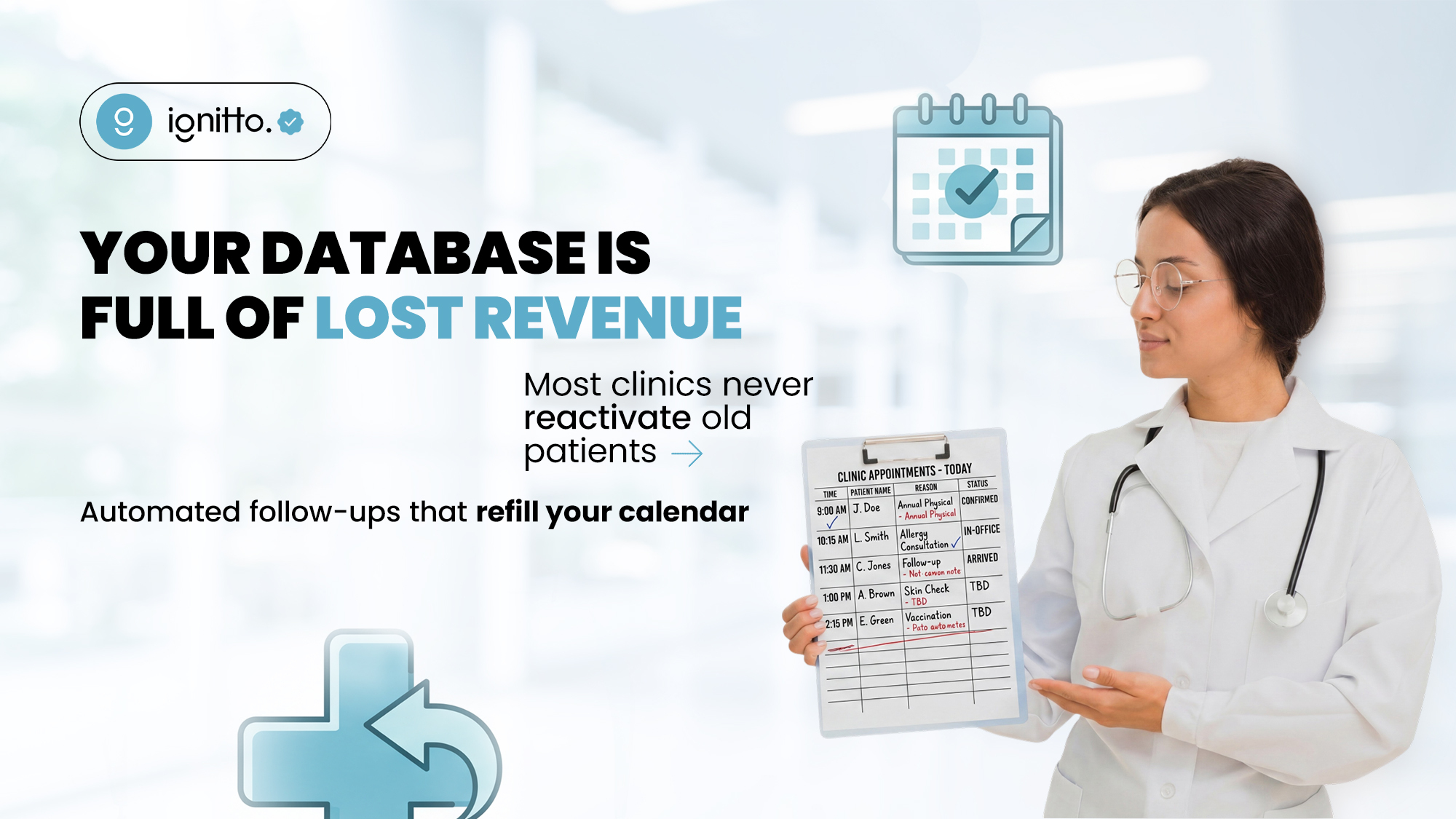
Patient Reactivation is one of the most overlooked growth opportunities in healthcare marketing. Your clinic is sitting on hidden revenue right now, not in a new marketing channel or a bigger ad budget, but inside your existing patient database. It lives in the records of people who visited once, had a good experience, and then quietly stopped coming back.
| TL;DR Summary Patient reactivation helps clinics recover lost revenue by bringing lapsed patients back through automated, well-timed follow-up campaigns. Instead of relying only on expensive new patient acquisition, clinics can increase appointments and retention using the patient database they already have. Ignitto automates the entire patient reactivation process with personalized SMS, email, and follow-up sequences connected directly to your CRM and booking system. Book a strategy session to see how a fully automated patient reactivation system could help your clinic generate more repeat appointments and long-term revenue. |
Patient reactivation is the process of re-engaging those lapsed patients and bringing them back into your appointment calendar. It is also one of the highest-return activities a clinic can run. Reactivating a former patient costs five to six times less than acquiring a new one. Yet most clinics never do it at all.
The numbers make a strong case. A clinic with 2,000 lapsed patients and a 20% reactivation rate recovers 400 appointments. At an average value of $200 per visit, that is $80,000 in recovered revenue, often from a single automated campaign. If you want to see what patient reactivation looks like for your specific clinic, Book a strategy session with the Ignitto team and get a clear plan built around your patient data.
This article explains why patient reactivation works, what stops most clinics from doing it, and how the right automated system turns your dormant patient list into a consistent revenue stream.
Why Every Clinic Has Lapsed Patients
First, it is worth understanding why patients disappear. Most clinics assume lapsed patients were unhappy. In reality, that is rarely the case. Research shows that patients leave for far simpler reasons.
Life gets busy. Patients mean to rebook after a treatment but forget. Work pressures, family commitments, and daily distractions push the appointment further and further down the list. Then months pass, and the patient feels slightly awkward about returning after a long gap. So they do not.
In many cases, the clinic simply never reached out. No follow-up message, no check-in, no reason to come back. Consequently, the patient drifts away without any bad feeling. They are not lost to a competitor. They are just waiting for someone to remind them you exist.
The typical clinic loses 15% to 20% of its patient base every year through this kind of natural attrition. For a practice with 2,000 active patients, that is 300 to 400 people walking out the door annually. Moreover, each of those patients represents not just one visit, but a lifetime of potential appointments and referrals.
The Real Value of a Lapsed Patient
Lapsed patients are not the same as new prospects. They already know your clinic. They have met your team, experienced your environment, and had a result good enough to share their contact details. That starting point is enormously valuable.
New patients require significant investment. You spend money to attract them through ads, SEO, and referrals. Then you spend time onboarding them, building trust, and converting them into regular visitors. Most practices find it takes a full year before they recoup the cost of acquiring a new patient.
In contrast, a lapsed patient needs none of that. They already trust you. All they need is a well-timed message that feels personal and gives them a clear reason to come back. As a result, patient reactivation campaigns consistently deliver three to five times higher return on investment than new patient acquisition campaigns for the same budget.
Furthermore, reactivated patients tend to become more loyal than before. A message that acknowledges the gap and welcomes them back creates a stronger emotional connection. They feel valued, and that feeling turns into repeat visits and word-of-mouth referrals.
Why Patient Reactivation Fails Without a System
Most clinics know they should reach out to lapsed patients. Very few actually do it consistently. The reason is the same as with most patient communication challenges: it depends on someone remembering to do it manually.
A front desk team handling daily bookings, walk-ins, and phone calls does not have time to pull a list of patients who have not visited in six months, personalise a message for each one, and follow up with those who do not respond. Even when someone tries, the process is inconsistent. Some patients get contacted. Most do not.
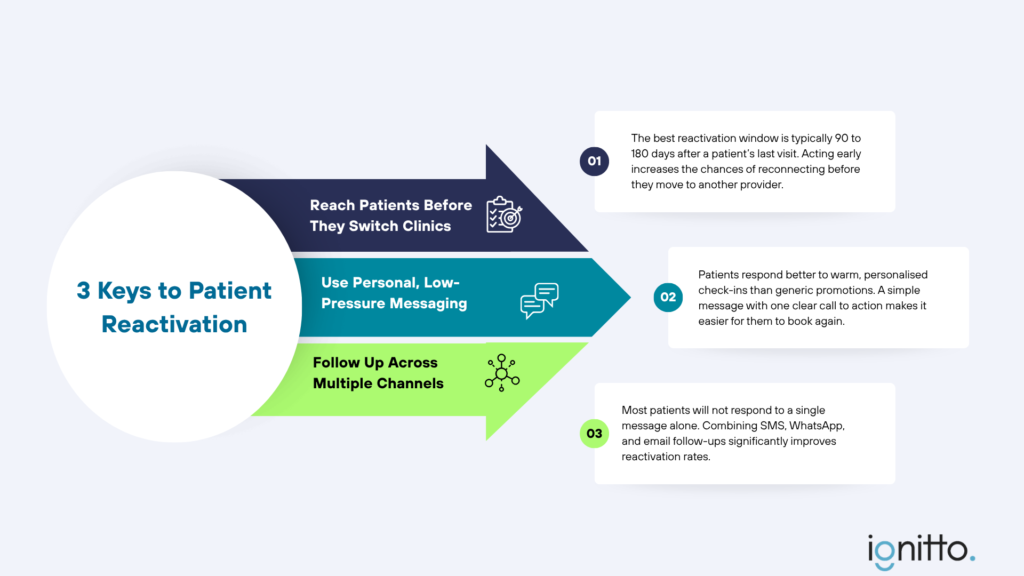
Beyond that, timing matters enormously in patient reactivation. The sweet spot for reaching a lapsed patient is 90 to 180 days after their last visit, depending on your treatment cycle. Contact them too early and it feels pushy. Contact them too late and they have already moved on to another provider. Manual processes almost never hit that window reliably.
Therefore, the only way to run effective patient reactivation at scale is through automation. A system that monitors your patient database, identifies who has lapsed, and sends the right message at the right time, automatically, every single month.
What an Effective Patient Reactivation Campaign Looks Like
A strong patient reactivation campaign has three key elements. Each one works together to maximise the number of patients who respond and book.
1. The Right Timing
Timing drives response rates more than almost any other factor. Patients who lapsed 90 to 180 days ago still remember your clinic clearly and have not yet established a relationship with a competitor. That window is where reactivation campaigns perform best.
For patients who lapsed 6 to 24 months ago, the approach needs more warmth and a clearer reason to return. After 24 months, recovery rates drop significantly. Consequently, the goal is to catch lapsed patients early, before they make a permanent switch to another provider.
2. A Personal, Non-Pushy Message
The tone of your reactivation message matters as much as the timing. A message that says, “We have not seen you in a while and wanted to check in,” performs far better than a promotional blast. Patients respond to warmth and personalisation. They ignore generic marketing.
Effective reactivation messages acknowledge the gap naturally. They remind the patient of a treatment they previously had or expressed interest in. They offer a simple, low-pressure invitation to come back. In addition, they include one clear call to action: book an appointment. No clutter, no multiple offers, no confusion.
3. A Multi-Channel Follow-Up Sequence
Single-touch reactivation rarely works. Most patients need more than one message before they take action. A well-structured sequence starts with an SMS or WhatsApp message, follows up with an email a few days later, and then sends a final reminder to non-responders a week after that.
Research shows that SMS reactivation messages achieve response rates of 15% to 25% when personalized with the patient’s name and last visit context. Email follow-ups add a further layer of reach for patients who missed or ignored the text. Together, a three-touch sequence recovers a significantly larger share of lapsed patients than any single message could alone.
Patient Reactivation by Specialty: Where the Return Is Highest
Patient reactivation delivers strong results across all clinic types. However, the return is especially compelling in practices where treatment cycles are predictable and patient lifetime value is high.
- Aesthetic clinics: treatments like skin boosters, anti-wrinkle injections, and body contouring need repeating every few months. A patient who completed a course and went quiet is an ideal reactivation target. They already love the results. They just need a nudge.
- Hair transplant clinics: post-procedure follow-up visits and additional treatment sessions are natural reactivation opportunities. Many patients plan to return for a second session but never get around to booking without a prompt.
- Dental practices: check-up cycles make dental patient reactivation highly predictable. A patient overdue for a hygiene appointment responds well to a simple, friendly reminder that frames the visit as routine care.
- Medical spas: repeat treatment revenue drives profitability in this category. An automated reactivation sequence keeps patients in their treatment cycle instead of letting it lapse between courses.
- Dermatologists: seasonal skin concerns, ongoing treatment plans, and review appointments all create natural reactivation triggers throughout the year.
- Chiropractors: maintenance visit schedules give clinics a built-in reason to reach out to patients who have not booked since their initial treatment course ended.
How Patient Reactivation Fits Into a Full Marketing System
Patient reactivation does not work in isolation. It performs best when it connects to the wider systems that drive patient acquisition and retention in your clinic.
For instance, your Google review profile plays a direct role in reactivation. When a lapsed patient receives your message and considers coming back, many of them check your Google profile first. A strong review rating with recent feedback reassures them that the quality they remember is still there. A weak profile creates doubt and reduces the likelihood they rebook.
Similarly, a strong patient reactivation sequence feeds back into your review profile. When reactivated patients return and have another positive experience, an automated review request follows their visit. As a result, your Google rating stays fresh and credible, which in turn makes future reactivation campaigns more effective.
Beyond that, patient reactivation connects directly to your appointment reminder system. A patient who comes back after a reactivation campaign enters the same automated follow-up sequence as any other patient. They receive reminders before their appointment, confirmation requests, and a post-visit review request. The whole system reinforces itself. This is exactly how Ignitto’s done-for-you marketing service is built, with every channel working together rather than operating in isolation.
How Ignitto Runs Patient Reactivation for Clinics
Ignitto builds patient reactivation directly into the workflow for every clinic it works with. The system connects to your booking and CRM setup via GoHighLevel. As a result, it monitors your patient database automatically, identifies who has lapsed based on your treatment cycle, and sends a personalized multi-channel reactivation sequence without any manual input from your team. This is part of Ignitto’s broader done-for-you marketing service for clinics, where every element of patient acquisition and retention runs automatically in the background.
The results build steadily over time. Clinics running automated patient reactivation campaigns typically recover a meaningful share of their lapsed patient base within the first 60 to 90 days. More importantly, the system keeps running every month. Each month, newly lapsed patients enter the sequence automatically. Each month, a fresh group of former patients receives a well-timed invitation to return.
Furthermore, every reactivated patient who returns feeds back into the review, reminder, and retention systems. So the value of each recovered patient compounds far beyond their first returning visit. You get the appointment, the review, and the ongoing relationship, all from a single automated process.
The Revenue Sitting in Your Patient Database Right Now
Think about this concretely. If your clinic has seen 3,000 patients in the last five years and only 1,200 are active today, you have 1,800 lapsed patients in your database. At a conservative 15% reactivation rate, that is 270 returning appointments. At an average value of $250 per visit, that is $67,500 in recovered revenue from patients you already paid to acquire.
In addition, many of those patients go on to book follow-up treatments, refer friends and family, and leave reviews that attract new patients. The true value of a successful patient reactivation campaign is always larger than the initial bookings suggest.
Most clinics ignore this opportunity entirely. Their patient database grows every year, their active list stays flat, and the gap between the two widens quietly without anyone measuring it. Meanwhile, their marketing budget focuses entirely on new patient acquisition, which costs five to six times more per booking than reactivation would.
Start Recovering the Patients Already in Your Database
If your clinic has lapsed patients sitting in your database, patient reactivation is the fastest way to turn that data into revenue. Book a free strategy call with the Ignitto team and find out how an automated reactivation system can be built into your practice alongside a complete done-for-you marketing setup that keeps your appointment calendar consistently full.
Visit our Website Iloveghl for more Articles.






Be First to Comment